

I’ve just completely re-written this guide from scratch, giving you the most advanced product research method available today 😉 This is the Ultimate Step-by-Step Guide on How to Find a Profitable Product! 🎉
You’ve probably seen my mega–guides about how to start an Amazon / E-Commerce business from scratch…
Haven’t read those yet? Check ’em out sometime!
After reading those, you’ll probably end up with the #1 most common question I get…
“How EXACTLY Do You Find a Profitable Product to Sell?”
Today’s mega-guide will answer that for you in-depth…
I’ll also give you some of my custom tools / spreadsheets I’ve been tweaking for over 10-years (since I started selling online) to help myself find those profitable products QUICKLY.
The truth is – product research & selection is super complicated and time consuming. Most people will literally drive themselves crazy and quit the business before mastering it…

But today I’m going to give you all of these quick rules and awesome tools to quickly identify high opportunity products, compare those opportunities against each other, and ultimately select the product that’s best for you to build a new business out of.
I’m confident there is no better guide (paid or free) that will help you find success on Amazon quicker than this 😎
So let’s get started!
Table of Contents
Who’s This Mega-Guide Made For?
If you’ve been with me for a while, you’ll know that there are several different forms of e-commerce…
To quickly simplify – the differences between the models is roughly determined by:
- What product you’re selling (are you flipping items from garage sales or having one product manufactured that you’ll sell many times?)
- Where you’re selling it (are you selling on a third-party platform like Amazon, building your own Shopify store or selling on social media?)
If you’re looking to make more than the average full-time income, then you can immediately eliminate low-margin e-commerce models like merch by Amazon, dropshipping and arbitrage.
That’s not to say there’s not value in those models. I know a LOT of successful sellers who started with arbitrage (if you want to learn more about arbitrage, check out my mega-guide on getting started with retail arbitrage).
But if you’re looking to replace your full-time income and obtain some real financial freedom, you need to be looking at wholesale and private label…
You want to be selling a few products to lots of people with potential for high profit margins.
Today’s guide will show you exactly how to do that…
We’re going to be working with Amazon’s sales data (almost exclusively). But because such a large share of all physical product sales are happening on Amazon – this method can be used to find profitable products for you to sell on either Amazon or your own Shopify store.
Alright…so let’s get started for real 🙃
Step 1: What Makes a Good Product?
Alright – are you ready? We are going to cram a LOT of value into this little section…

I’ve now personally sold over $100-million in physical products online (for new readers – you can view my current sales stats here) and helped over 7,000 new entrepreneurs launch new Amazon businesses (through my coaching community & course)…
So when it comes to finding profitable products to launch new online businesses, I don’t think there’s anyone who has seen more than me!
I’m going to try to package ALL of that into this ONE section. Let’s see how it goes…
Why Most People Fail
Global e-commerce sales have consistently grown at about 25% per year. That growth has made Amazon worth over $1-TRillion (with over 50% of their physical product sales coming from 3rd-party sellers like you and me 🤑)
Those numbers prove there’s never been an easier time to get a profitable e-commerce business off the ground – either on Amazon or your own store…
Yet – most people who set out to succeed will never even find a profitable product to sell…
Here’s why that happens –
- Perfect Product Paralysis: Most people get stuck looking for the ‘perfect product’ and never get started at all…
There’s no such thing as the perfect product.
Every product has challenges to overcome – and profit for those who do.In this guide, you’ll gain a deep understanding of what drives product profitability (and what actually makes a good product).
As you’ll see – product profitability changes over time, and all products have pro’s and con’s…Your job is to find ANY PROFITABLE PRODUCT and LAUNCH IT – then grow from there… - Information Overload: Too much learning and too much information leads to confusion and a lack of confidence – making it seem like everybody has it figured out but you…
Learning is NOT a productive task – NOTHING is being produced. Implementing what you are learning is the only way to succeed in business.
Those who implement the most (messy as it may be) will be the most successful. And those who learn the most will be most upset about it. - Thinking Too High Level: I get emails every day saying things like ‘Will – should I sell pet products or iPhone accessories?’…That’s thinking WAY too broad for where we’re at in the process!
What we’re looking for right now is ONE profitable product to sell. We don’t want a profitable niche, we don’t want a profitable category – we want ONE…profitable…product…From one profitable product – comes two. And from there…well you know 😀
When you’re first starting out, it’s easy to completely overwhelm yourself by planning the entire future of your empire. You get stuck on the tiny details like where to buy UPC codes. You instead need to wake up every day and take the next smallest step you can to achieve that dream.
After you’ve got some products selling and you’re making some money, you’ll turn around and optimize your product catalog – sacrificing your low profit products for new opportunities and consolidating your best products into product lines & brands.
Profit FIRST – empire later… - Following the Herd: You don’t want to follow the exact same methodology everybody else is using. And there is no ‘Yes / No System’ that tells you what products will be profitable…
However, there are many that try. Even my personal favorite product research tool (Market Intelligence) has something similar –
These types of things are designed to be sexy and sell the software, which it does. But I’ve yet to meet anybody who built a successful e-commerce business because they saw a high idea score…
Following things like this robs you of a true understanding of what makes a profitable product (and thus, how to build a business).
You need to be more concerned with the DATA these tools provide, and be able to forecast how that data will play out in the real world.
Which brings me to my next point… - No Ability to Future Forecast: Most people who try to get into this business honestly never get beyond comparing prices on Amazon vs Alibaba vs Aliexpress.
After reading this guide (maybe a couple times over 😉) – you’ll be able to future forecast out and get an accurate estimate of things like profit margin, order costs, shipping costs, net profit per order, and many other awesome metrics…
In this guide, I’ll be referencing my personal Product Research Workbook quite often…
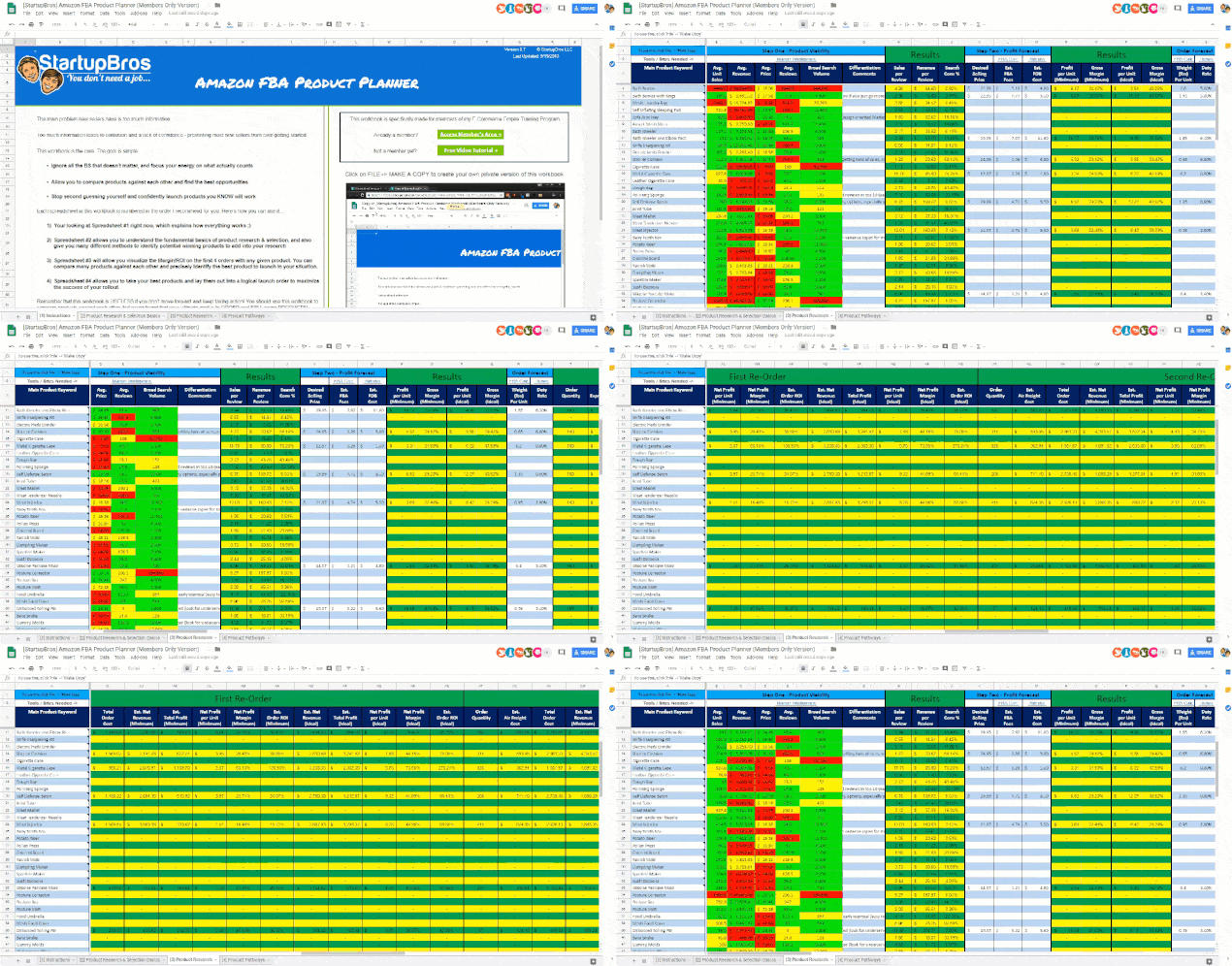
The workbook allows you to apply the principles I’ll cover in this guide quickly and efficiently – processing hundreds of products through my personal product selection system within hours.
Armed with the ability to forecast all of this information, I hope you’ll finally feel confident enough in your product selection to finally move forward and take the leap.
So that’s what NOT to do. Let’s get into what you actually WANT to do…
Basic Unbreakable Product Parameters
Like panning for gold, this is the first set of filters you’ll put your product ideas through…

Let me explain each one a bit more…
- Small, light, and simple to ship – The bigger and heavier your product is, the more expensive shipping is. And shipping is typically the 2nd biggest expense in this business.
You also want to avoid fragile products and products with lots of moving parts. The more complex a product is – the higher your return rate, which again drives up shipping costs. So we want to avoid that…
By the way – the actual numbers in the table above come from Amazon FBA’s classifications of Small Standard-Size (15-inches) and Large Standard-Size (18-inches). Staying within these size limitations will ensure your product fulfillment fees stay low (and your profit margins stay high). - Selling to consumers for $15 – $100 (preferably $20 – 75) – Any product selling under $15 is going to have almost no profit margin left after paying sales fees, advertising costs, shipping & handling, storage, etc.
So if you’re just getting started and want to make any decent sum of money in this business, you can automatically cross off any product selling under $15
On the other end – the higher the selling price of a product, the more it’s going to cost you to get started selling it (you know – inventory…).
While there is no high-end limit, you can simply add two zeros to the end of your product’s selling price to get a (very) rough idea of how much investment will be required before reaching profitability…
So a $15 will likely require $1,500 of investment before becoming a profitable revenue stream, while a $50 product will likely require $5,000 before becoming profitable. - Profitable product and efficient use of capital – You obviously want products that are profitable to sell (fair profit margin) and are an efficient use of capital (good ROI).
When you’re first getting started, you can simplify these complex terms down to what I call the ‘3x Rule’ – whatever price you buy a product for, you’re aiming to sell it for at least 3x your cost.
We’ll still use profit margin and ROI to compare products against each other (and find the very best opportunity to move forward with). But the 3x Rule is handy to have in your conceptual toolbox.
Also – keep in mind that profit margin increases over time. Sometimes you may want to just break even on a competitive product, so you can launch that new revenue stream for your company. After launching the product, you can then work on increasing profit margins.
That’s why in my personal workbook, I calculate profit margin and ROI all the way out beyond the 3rd re-order. I need to see how my margins are going to change over time as I scale the product up (paying less per unit in both inventory and shipping costs).
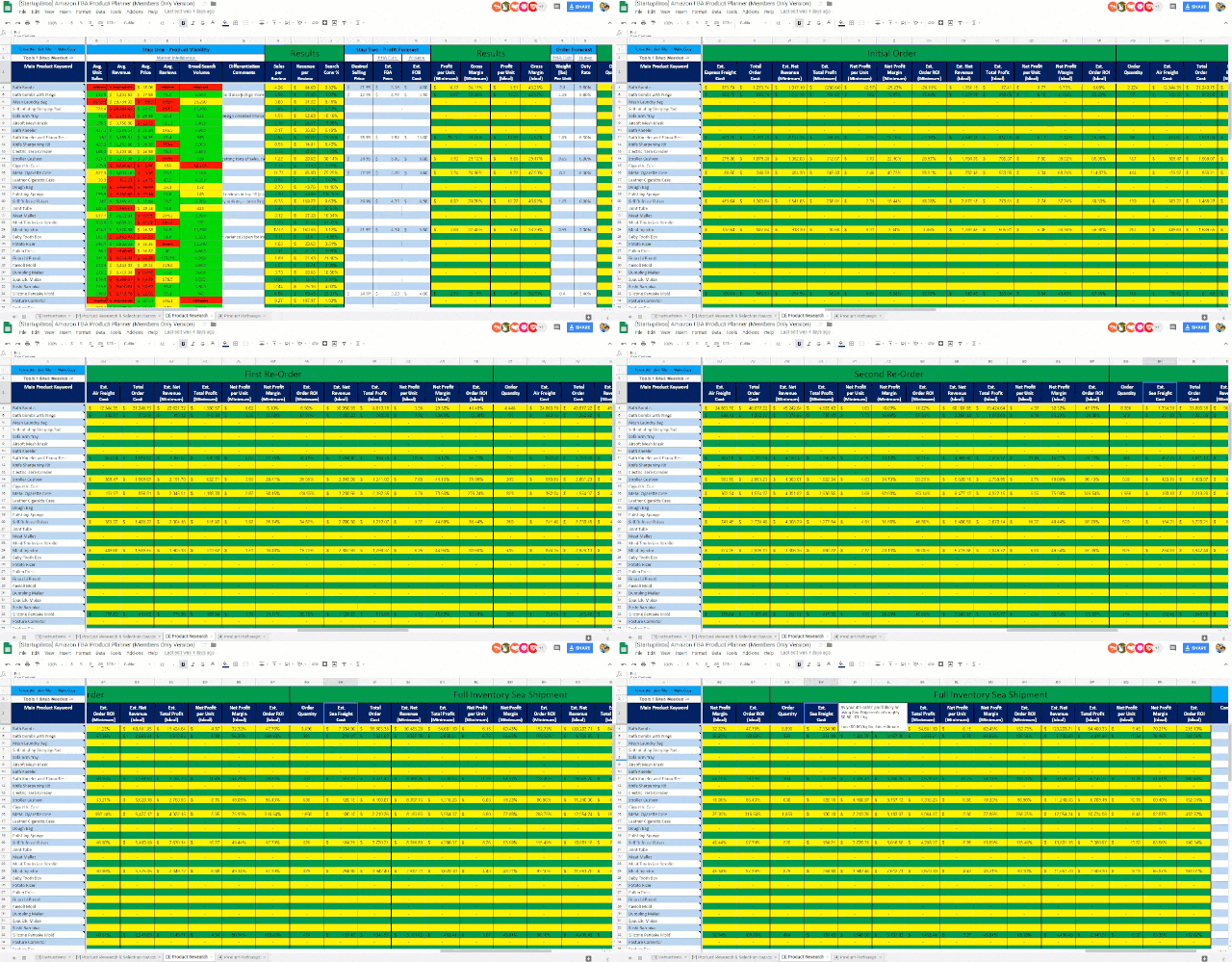
I’ll show you exactly how to do that later in this guide…
Alright…still with me?
Like I said – this is going to be a pretty deep guide 👍
Other Concepts You Should Know
- Understand the Product Life Cycle – One of the most important concepts in e-commerce that nobody talks about. You can NOT succeed with products that are outside of the growth phase of the product life cycle.
Instead of typing out an explanation of the product life cycle, here’s a video I did on my fancy Star Wars-esque lightboard
- Don’t Fear Competition – Nobody wins in business by avoiding competition. But for many people, that’s their primary concern while researching products 🙁
You can’t attack this process from a fear mindset. You have to attack it from an abundance mindset.
Get excited about the products you might birth into this world, and don’t underestimate how much better you’ll make your product for your customers over time. This is just the beginning of your empire!
The only thing to fear is a LACK of competition – which signals a dead market not worth anybody’s time.
Using the methods in this guide, you’ll find rapidly growing products that are early in their life cycle – and then you’ll launch into that growing demand and claim your market share 😀 - You Must Add Value – When you’re first starting out, you don’t want to immediately start customizing your product…
You might place a logo on your product, but in terms of customizing the physical product itself (or adding expensive packaging, bonus products/bundles, etc) – let’s leave all of that for after we’ve got this product up and selling.
The trick to getting started is again – finding a product with growing demand, and growing with that demand. That allows you to start with a relatively simple, unmodified product.
And then with each order, you want to keep trying to add more value based on customer feedback and ranking data….but I am probably getting a little ahead of myself here.
The point I want to make here is – try to find products you’re passionate about…
I would say that about 80% of all sellers I know are not at all passionate about the product they sell. It’s simply a business to them – they don’t even have the life experience to innovate or improve the products much.
However – sellers who find products that hit all these parameters AND fall within their passions and life experience?
Those sellers are so in-touch with their customers that they end up defining the market and dominating their competitors. And they have a lot of fun doing it!
So understand that you will likely start with a relatively generic product, but you can quickly start tweaking things with your supplier to REALLY differentiate and leave all your competitors scrambling to keep up…
The trick is again – get profitable first, then build the empire.
If you’ve read this far, you’re already ahead of 95% of all new sellers. These are damn important concepts, and those who understand them will WIN against those who don’t…
Advanced Product Selection Concepts
At the risk of getting waayyyy too advanced, I’ll give you a few more important concepts I’ve picked up over the years (I might even remove this section)…
- Too many sales is worse than too little sales – There is a sweet spot for sales numbers…
Too little sales means that you just won’t make much money…
You might have a good margin, but there just won’t be much volume. You’ll have to launch more products to increase revenue. Not too great, but not too bad either
Too many sales means you literally won’t be able to keep up with any inventory demands…
It will require way too much capital to keep up with sales. You’ll end up going out of stock constantly, potentially racking up debt, and not being able to keep up with the evolution of the product.
As I’ve said many times now – the trick in this is finding a product that’s early in its life cycle…
Something that has relatively low sales right now, but has a ton of growth ahead of it. Those are the markets you can grow with and dominate over time.

- You want products with a low number of average reviews – In this guide (and specifically in my workbook), I will show you how to collect the Average # of Reviews for your product. This will tell us how many reviews your top product competitors already have.
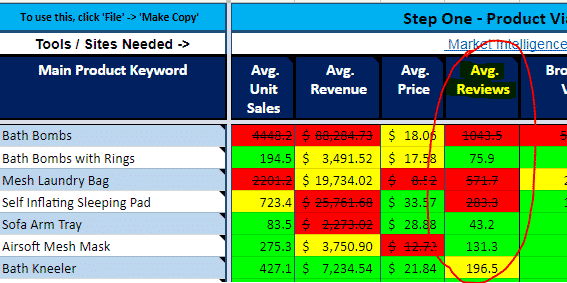
The higher this number is, the tougher it’s going to be for you to compete (for the most part).
There’s a sweet spot for this number that will show you which products are early in their life cycle (and thus – which products you want to go for!)
I’ll show you how to find that sweet spot later in this guide…

- This is a comparison process – Like I said earlier – if you’re just clicking around looking for the perfect product to sell, you’re going to drive yourself crazy (and fail)…
Amazon allows us to get incredibly accurate estimates of how profitable each product will be. So we should obviously use them!
The trick to efficient product research is separating yourself from the products themselves, and just strictly looking at the data that matters. Use that data to future forecast out and compare how each product will perform against each other product you’re researching…
This way – you don’t need to find the perfect product. You’ll be extremely confident in the BEST product you’ve found – the one that’s beat all the others…
The truth is – big sellers like me barely even research products any more. We simply launch a ton of products, and accept that 30% – 50% will fail. The ones that win end up being profitable revenue streams for years
But for YOU – you need your first few products to WORK! So you will spend more time with this data, and you will filter and compare all your estimates until you’ve found your BEST product opportunity.
And then you will move forward with confidence 😉
Alright – so you’ve just gotten a masterclass on product research & selection concepts.
Let’s move into actually performing this research and selecting products…
Step 2: Brainstorm Products to Research
Now you know exactly what makes a great product for a new seller…
In the next section, we’ll walk through the actual comparison and selection process. But before we do that – we need to actually think of products to research and take through that comparison process!
Time For YOU To TAKE ACTION!
At this step, you’ll need to start keeping track of all the different products you want to research. I’ve made my own personal Product Research Workbook available to you for free as part of this guide…
If for some reason you don’t want this awesome tool I’ve spent over 10-years tweaking and perfecting, then you can also build your own from scratch…
In that case – you can open up either Google Sheets or Excel and start keeping track of product ideas as they come.
Either way – now you need to take action!
My Favorite Brainstorming Methods
So at this stage – we are not really thinking about prices or profitability. We are simply trying to find high-potential products to then check and compare their profitability later.
There’s no right or wrong way to brainstorm products. Most people start by randomly walking around and looking for products that catch their eye. And that sometimes works!
But you know I’ve got a better method for you 😉
Here’s some of the different brainstorming methods I recommend in my e-commerce coaching program –
- Passions, Interest, Hobbies & Problems: Roughly akin to walking around and looking for products that catch your eye, but way more focused on products that you can actually build a business out of.
I’ll give you just one more freebie from my coaching program – a worksheet to track your Passions, Interests, Hobbies & Problems. You’ll want to print this out and carry it around with you while you’re brainstorming products.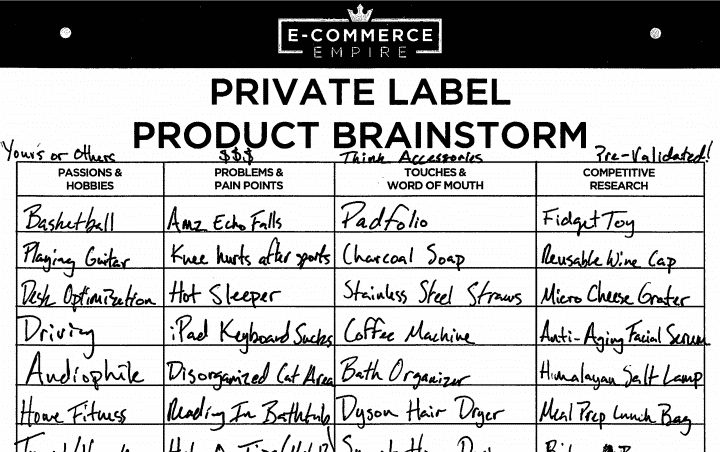
The idea here is to identify some of the less-obvious product opportunities that you could sell better than most other sellers. Products that fall into these categories are typically higher margin than most others too.
So think about the passions, interests, and hobbies that drive you. Start thinking about some of the cool products you’ve seen recently in there. And start writing those products down!I also like to think about pain points. Most products on Amazon are bought because someone wants to solve some problem or eliminate some pain point. So any time I (or someone I know) complains about some problem or pain point, I am thinking of how that complaint is going to look as an Amazon search term.
If you’re still having trouble with this concept, you can also download this example worksheet that I pre-filled with sample ideas…
- Trend Hunting: The idea here is to explore up-and-coming product trends. And there’s a few sources that are great for this (and a ton of sources that are a waste of time).
There’s not much to explain here. You simply go through some of these websites and look for things that catch your eye (and are within the unbreakable product parameters, of course) –- Kickstarter’s Trending Products
- This Product Inspiration Site
- TrendHunter’s Pro Consumer Insights (don’t buy anything here, just scroll down and click around)
- Reddit has lots of subreddits that supply a steady source of trending product inspiration
- Pinterest is also a great source for brainstorming inspiration (try searching high-level terms like ‘survival gear’ or ‘mens beauty products’)
There’s many other sources, but I’ve found those to be the best…
- All the Amazon Methods: You’ll often hear people recommend browsing the Amazon Best Sellers List to find potential products to research. However, this is a waste of time for new sellers…
If you’re going to spend time mindlessly scrolling through Amazon’s catalog, make sure you’re in the Movers & Shakers or Hot New Products.
While it’s not my favorite brainstorming method, you can find some great product ideas that way… - Spying on Other Sellers: Although this is the ‘sexiest’ and most powerful method, I have to warn you…
I do NOT recommend blindly following other sellers and just selling whatever product they are. That’s a recipe to always be behind the curve playing catch-up to the real winners…
But I do LOVE the idea of spying on my competition, and seeing what products they’re currently investing new money into…
So use this method to gather intelligence and brainstorm – not simply become another ‘me-too’ seller.With that being said – here’s how you do it…
- Spy on Sponsored Product Ads: These little ads on Amazon can tell you a lot about who’s making money…


For a seller to be pushing a product with these ads, they MUST have high enough profit margins & volume to cover all their typical costs (inventory, fees, etc) – and ALSO pay for advertising expenses on top of that. All while still making a profit!
And these are exactly the kind of products I want to be selling. To quote the man who has forever changed the way we buy things –
Your Margin Is My Opportunity.
– Jeff Bezos (Founder @ Amazon)
Since sponsored product ads (and advertising in general) show you who has high-ish margins, they can be a great source of product ideas.
- Spy On Other Seller’s Product Launches: This one is a little dirty, and will certainly rub some people the wrong way. But I want to give you the best chance of success, even if it pisses some people off (including some friends)…
One method I stumbled on long ago was spying on other seller’s new product launches. These are the product launches that they’re investing big bucks into – products they’re hoping will soon become a reliable revenue stream for years to come…
This will get a little advanced (like it hasn’t already 🙄), but many Amazon sellers in the most competitive categories will use free product giveaways and ‘launch campaigns’ to drive up ‘units sold’ on the Amazon platform.
This in turn tells Amazon their product is awesome, and so Amazon starts to show it more often to it’s real customers.Long story short, it’s a greyhat-ish way to increase your sales on Amazon
So what you can do, is sign up as a customer/buyer for the launch services that these sellers use. Then you will see the exact products they are spending thousands of dollars to rank well on Amazon.
Some of these launch services will not even require you to sign up. You can just go on their websites and see which products are currently being launched –
There are many other ways to spy on sellers, and many other launch sites that can be used. But since I am friends with most of the people who run these services, I am going to save the more advanced version of this method for members of my e-commerce coaching community 😉
Spend some time trying out all the different methods above, and try to get 10-20 solid ideas out of each one…
After that, you should have a spreadsheet with 40-80 products that we will take forward and research in the next step.
Once you have that, you can move on to the next step…
Step 3: Use Historical Sales Data to Forecast Future Product Profitability
That sounds really complicated, but it’s actually simple…
You’re going to use simple tools to find a few pieces of sales numbers for each product. And you’re going to put those numbers on a spreadsheet…
Then you’ll use some fun little formulas that crunch your data and forecast how each product will perform for you in the future. You’ll be able to see extremely accurate estimates of sales volume, profitability, and even how much your first order will cost you (and how much money you’ll make after you sell it all).
After you have all of this information – you’ll be able to quickly compare huge amounts of products against each other. You’ll translate the ‘big data’ of Amazon’s real sales history into a comprehensive story – and you’ll be able to visualize how each product will play out in real life.
I know this sounds absolutely crazy. But this is where I have personally taken it since I started selling physical products online over 10 years ago. And I will help you take your product research to that level with this guide!
My own personal product research workbook makes my entire comparison model readily available to you. I really suggest using my workbook from here on out – as most of the formulas I use to compare products against each other are simply too complex to explain in this guide…
However, I’ve made those formulas are readily available to you for free as part of this guide!
The Only Tools You Need
Right now there are only two tools you need…
- The Startupbros Product Research Workbook (or your own spreadsheet)
- Preferably
JungleScout ‘s Market Intelligence (which comes with a free trial)- JungleScout will work too, but I prefer Market Intelligence…
How to Actually Do the Product Research
You’ll see that my Product Research Workbook has the following pieces of data you need to input from one of these product research tools –


You’ll want to pull these numbers from Amazon using your Product Research Tool –

Two important things I want to note as you go into this…
My entire product research methodology revolves around this idea of becoming one of the top 10 Amazon sellers for that product (which is super easy)…
So when I use these product research tools, I am not really looking at the data for any individual product…

I am looking at the aggregate sales data for the top 10 product listings for that keyword.

This shows me how the average product in the top 10 currently performs, and gives me a more reliable idea of how my product might perform (compared to any one individual product listing, whose data can be skewed by external promotions, sponsored product ads, and discount campaigns, and lots more).
Why I Split My Research Into 3 Stages
My research is split up into 3 separate ‘stages’ – which allows me to quickly filter out bad products before wasting any unnecessary time on them…
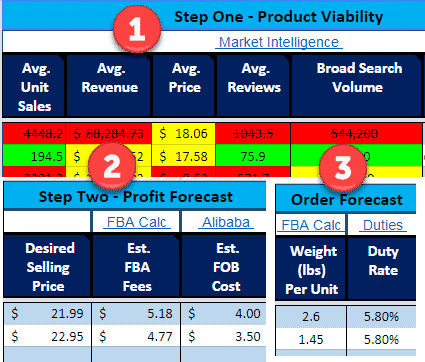
So when I perform product research, I am QUICKLY filling in the Stage One data points for each product – and then I only take the BEST products into Stage Two (and so forth).
By continually feeding small bits of data into the machine, and filtering out any products that don’t make the cut along the way – you’re saving countless hours you would have spent cluttering your mind with bad products that you should have known would suck anyways…
The name of the game right now is SPEED and EFFICIENCY. You do NOT want to spend the next 2-weeks doing product research. This is an over-the-weekend kind of task…
Now go through and fill in the data for each product idea you’ve come up with…
- Search for your product on Amazon

- Analyze using your product research tool
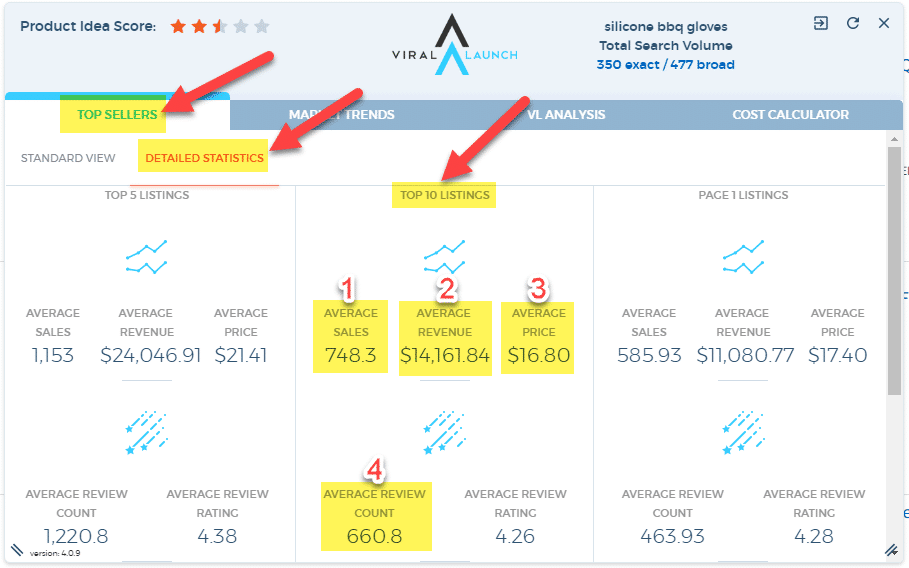
- Input the numbers you need into your workbook
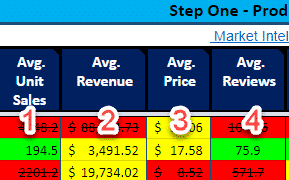
(you can also use different product analysis tools)
Stage 1 – Is the Product Even Viable?
Your workbook should now look something like this –

You now have all the data you need to quickly check the viability of each product, and knock out all the products that obviously suck.
All your time will now be focused on your best product ideas.
There’s a few things you’re looking for before taking any product into the next stage of research…
- Average Price: This number now shows you how much each of the top 10 sellers is charging for this product.
Most of the time you’ll sell at a slightly higher price than this – but consider this your worst-case-scenario price.
Any product with an Avg Price under $15 is NOT going to make it into the next stage. These products just won’t be profitable – you can’t start a business out of them
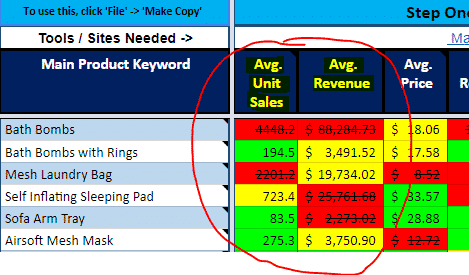
Any product with an Avg Price over $50 is not necessarily a bad product, but it will cost a fortune to buy inventory to start selling it. These products are best left for the future, after you’ve got some profitable cash flow coming in? - Average Unit Sales & Average Revenue: Like we talked about (way) above, too many sales is bad for new sellers…
We’re aiming for a sweet spot – a product we can get started with on a relatively low budget, achieve profitability quickly, and then grow with the market naturally from there.
Any product with an Avg Revenue under $3,000 is NOT going to make it into the next stage.
These products might be profitable, but there is just not enough volume to make them viable products to build a business out of.
Any product with an Avg Revenue over $25,000 is not necessarily a bad product, but it will cost an absolute fortune to get started and compete for a market this large. These products are also best left for the future.
Ideally, you can find some products with $3,000 – $20,000 in Avg Revenue that are early in their life cycles. The idea is (once again) that you can launch into that growing demand and become a market leader by the time the market reaches those higher revenue numbers. - Average Reviews: This number now shows you how many reviews the average seller has (out of the top 10 sellers). It roughly shows you how many reviews you’ll need to be perceived as an obvious market leader to all new customers (which is when things start getting real easy…)
Any product with Avg Reviews under 25 is not necessarily a bad product – but it’s a red flag that the market may be too small to launch a business out of. More investigation is required before taking these products through to the next stage.
Any product with Avg Reviews over 200 is not necessarily a bad product either – but it’s a red flag that this market is already matured. Products have been perfected, marketing has been automated – and it might be very difficult to compete in these markets (compared to products with less reviews).
The sweet spot here is products with Avg Reviews between 25 – 200. Anything outside of this range is generally not going to make it through (especially on the high-end of 200, unless you’ve got experience and a big budget!). - Broad Search Volume & Search Conv %: You’ll see this metric on my personal workbook, but I do not recommend you use it…
I do go into this metric and how I personally use it in my e-commerce training program, but it’s simply too complex to explain via text here (and requires additional tools to perform).
So for you right now – just skip Broad Search Volume and Search Conv %… - Sales / Revenue Per Review: These are really cool metrics that I love to use. Both roughly show the same thing – how many sales (or how much money) are sellers making for each review on their product listing…
Using this metric along with Avg Reviews gives me a rough idea of where a product is at in its life cycle. A product with low Avg Reviews and high Sales/Revenue Per Review would mean the product is relatively new, has few reviews (and thus no market leader), and is STILL making crazy amounts of sales/money.
Those are obviously the types of products you want to be selling!
Any product with an Avg Sales Per Review under 2 OR Avg Revenue Per Review under $40 will NOT make it into the next stage. You can eliminate all these.
For these metrics, higher is better. Any product with high numbers in these columns – you’ll want to take forward into the next stage.
Using the rules above, you’ll typically eliminate the majority of the products on your workbook. This is a good thing!
You should be left with about 10-20 products to bring through into Stage Two…
Stage 2 – Is the Product Profitable?
Now you’ll collect just 3 numbers for each product that made it through to this stage. With just these 3 numbers (and the data you’ve already collected) – you’ll be able to eliminate any product that would not be profitable enough to support a new business.
Here’s the 3 numbers you need to calculate profitability –
1. Desired Selling Price: New sellers should be selling premium products at premium prices. In almost every circumstance, your product will sell at a slightly higher price than the Avg Price of the Top 10 Sellers (which we calculated in Stage One).
So on my own personal workbook, I make all estimates from Stage Two forward using both the Desired Selling Price (ideal scenario) AND the Avg Price (worst case scenario). Doing this gives me (and thus you) the ability to see what profitability will look like if I decide to abandon the product and liquidate it instead (I prefer to still profit in those situations!).
So your Desired Selling Price is just…your desired selling price. What do you want to sell this product for?
This question is second-nature to experienced sellers. If you’re a new seller and confused by this, just add 20% to the Avg Price for the product and move on…
2. Estimated FBA Fees: The second biggest expense in this business (sometimes the biggest expense) is SHIPPING – both getting your product from the supplier (sourcing/importing), and getting that product to the customer (fulfillment).
Typically shipping is pretty difficult to estimate. But this guide will show you how to get extremely accurate estimates of what your product will cost to fulfill
All you need to do is…
- Search For Your Product On Amazon
- Pull the ASIN for 1-3 Products
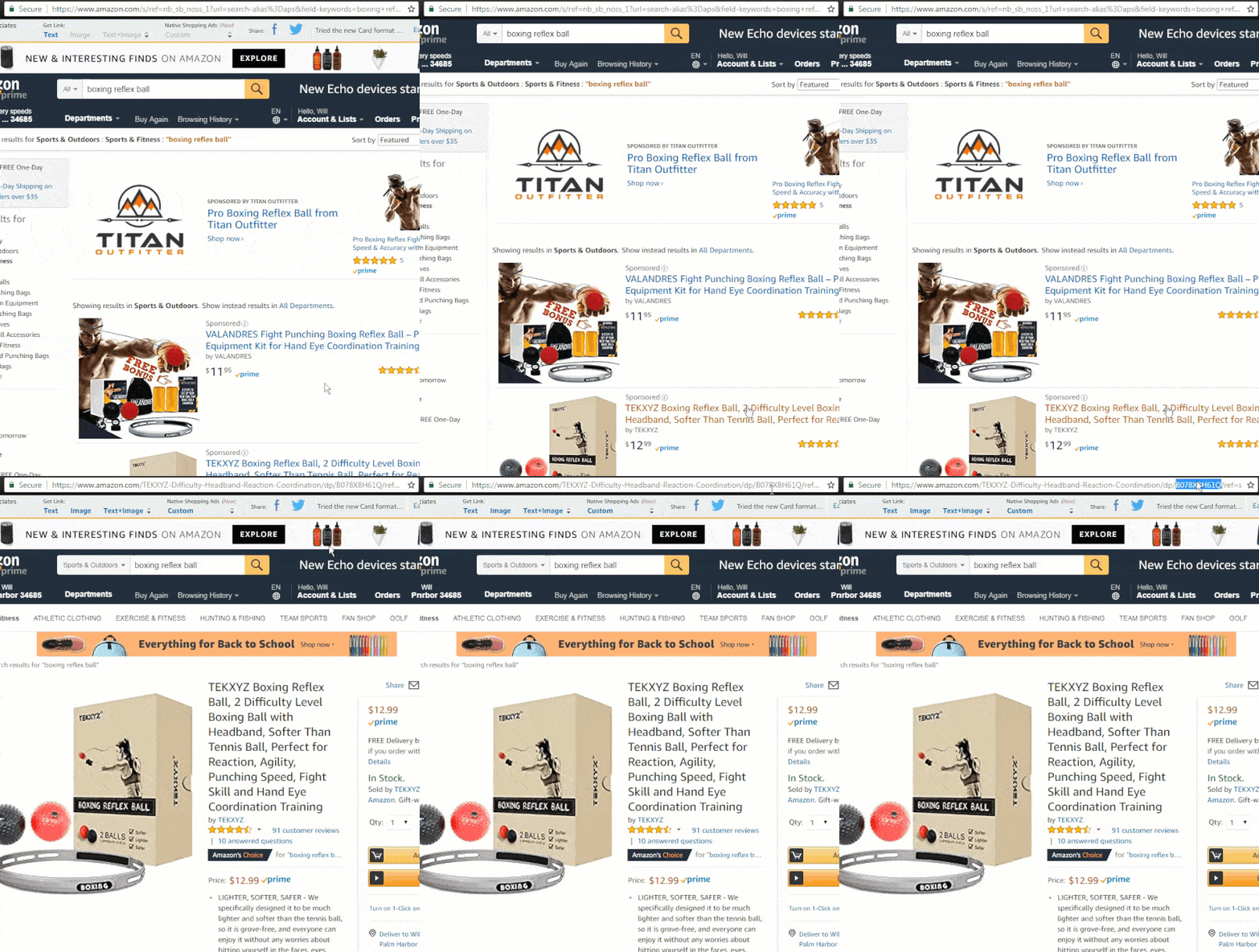
(I usually copy the ASIN from the URL of the product listing…)

- Plug that ASIN into Amazon’s FBA Calculator with ANY ‘Item Price’ to see the REAL fulfillment cost of that product 😎
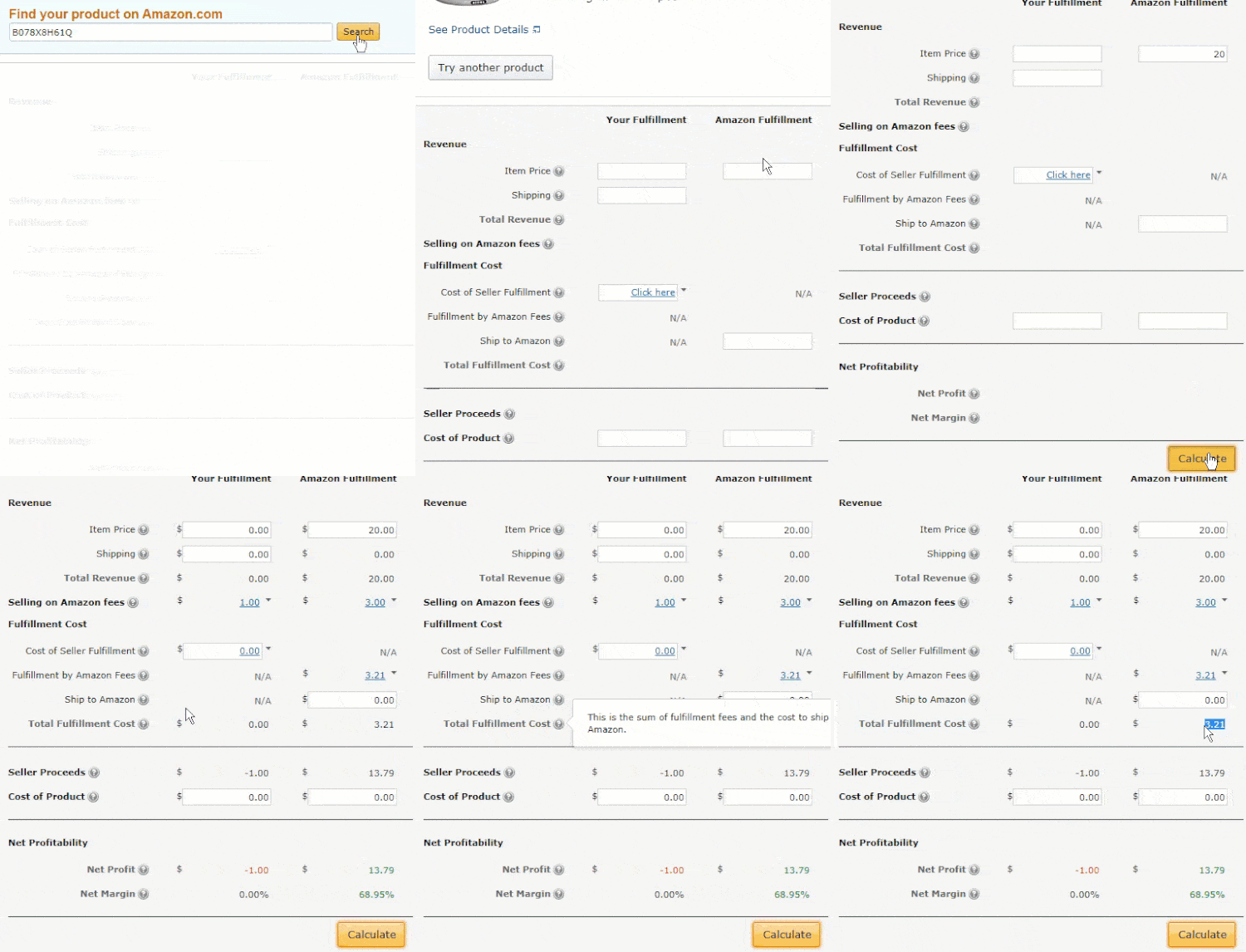
- Input the ‘FBA Fulfillment Fee’ or ‘Total Fulfillment Cost’ into your workbook
You’ve now got profitability estimates that account for the real-live fulfillment costs of each product.
Quick note – since my personal product research workbook is built for new Amazon sellers, it automatically accounts for the ‘Selling on Amazon Fee’ you’ll see on the FBA Calculator (which is of gross revenue).
3. FOB Costs:
Now we need to find out what this product is actually going to cost us. How much will each unit of inventory cost from the supplier?
This is the final number we need before we can calculate and compare the profitability of each product!
You’ll want to use Alibaba to search for your product and grab a quick FOB pricing estimate

At this stage you’ll need to start applying some creativity to the process. You’ve already searched for the product on Amazon and seen what the competition has to offer. And now you can explore products from suppliers around the world on Alibaba (yes, it’s legit).

So which of these products do you think you can sell? Which of these products do you personally think is awesome?
Browse around for less than 2-minutes per product and put your best estimate of the FOB Price into your workbook…

If you’re feeling unsure about your estimating skills, keep in mind that this is a comparison process! So if you underestimate or overestimate pricing across all your research – it won’t matter much. You’ll still be able to compare all those products and find the outliers that stand out among the rest.
And if you want more information on how to use Alibaba, check out my Alibaba Mega-Guide…
You’ve now got all the data you need to automatically calculate those extremely accurate estimates I keep ranting and raving about 😎
Stage 3 – Future Order Forecasting
Now you can start comparing the profitability of all these products against each other to find the best ones 🙂
Your workbook should look something like this –

This shows us both the Profit Per Unit and Gross Margin for each product. And it shows us both the minimum results we could expect (based on ‘Avg Price’ from Stage One), and it shows us the ideal results we could expect (based on ‘Ideal Price’ from Stage Two).
The reason this is Gross (and not Net) is because we are still missing one major expense – shipping from our supplier into our fulfillment center (usually Amazon FBA). We’ll grab this number in the next stage, but only for the products that make it through this profitability checkpoint.
I’ll make this section really simple for you…
Any product with a Profit Per Unit under $5 OR Gross Margin under 30% can automatically be eliminated. You simply can’t build a new business out of these products…
You’re really aiming for Profit Per Unit over $8 and Gross Margin over 40% at this stage. But the higher the better (did I mention it’s a comparison process?)…
How to Forecast Product Costs & Profits
By this point you’ll start to understand why I stress speed and efficiency, and why I split this up into 3 stages…
It’s freakin’ time consuming! And you don’t want to do this much in-depth number-crunching research for products that could be eliminated early in the process.
Luckily – this is the quickest step of all, and probably the coolest too 😎
There’s just two numbers you need to input into your workbook to complete your data destiny…

Here’s how to get those two numbers –
- Weight (lbs) Per Unit: You can get this number the same way you got the FBA Fees earlier…
Since Amazon is actually fulfilling these products for current sellers, you know this is the actual verified shipping weight!
Just open the Amazon FBA Calculator and search for your product on Amazon. Then pull the ASIN for 1-3 products, and input that ASIN into the FBA Calculator…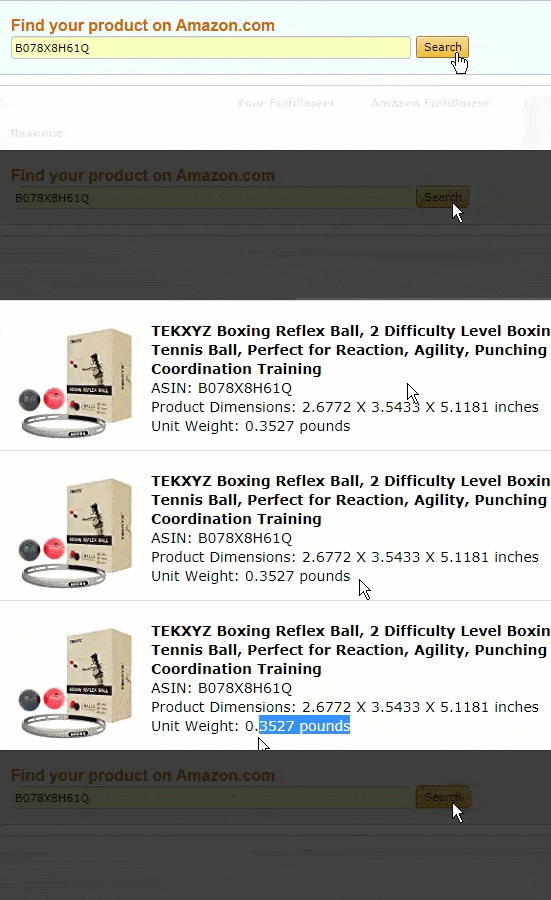
As you can see, Amazon will show you the shipping weight right here on the calculator. This is the actual shipping weight this seller is paying Amazon for via FBA – so you can count on it being pretty accurate!
Quick Note – As you get the hang of this, you may also want to start simply inputting the Weight Per Unit when you are collecting the FBA Fees using the calculator earlier in Stage Two. It’s just a little quicker that way…
Once you have that number, enter it into your workbook!
My workbook (that you are hopefully using by now) will automagically take this one number, convert it into kg, and then use it throughout the Stage Three results to produce extremely accurate shipping estimates…
- Duty Rate: This is the final number you need to input into your workbook 🙏
To be honest, you probably won’t ever find another product research guide that takes duty rate into account. Even some of the most successful sellers I know don’t know how to estimate duty rates.
But I have a method to quickly pull accurate duty rate estimates. And once you have those, you’ll have accounted for every predictable and repeated cost of doing business with each product.
And you’ll have no excuse not to finally pull the trigger and get started!There’s two good sites you can use to estimate duty rates –
- HTS Search (from US Government)
- FindHS.Codes
There’s one additional way to get duty rates even quicker, but I do need to leave that private to members of my coaching program – as it will get locked up if made public…
You’re basically just searching around these systems to find something that would accurately describe the product you’re importing. When you find an HS Code that applies to your product, take that duty rate and input that number into your workbook.
Sometimes this will be easy, and the product will come up right away. But other times you will have to dig a little bit, and maybe even go with a very broad category (maybe you can’t find Stainless Steel Garlic Press, but you can find Steel Kitchen Products).
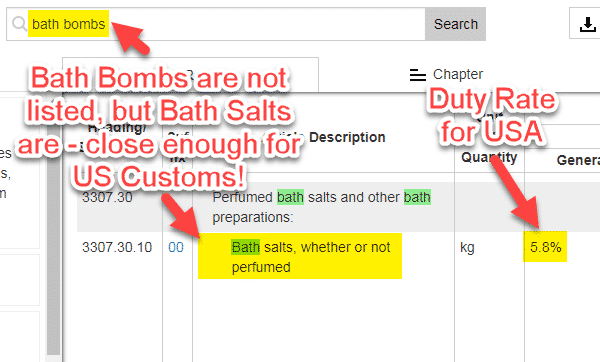
If the duty rate for your product is outrageously high, look around for another classification that might have a lower duty rate. YOU determine the classification, and there is some flexibility with these things…

You’ll also see the term ‘Merchandise Processing Fee’ or ‘MPF’ come up often. This is a small fee (typically $25) that US Customs charges to process each and every shipment coming through the border…
My workbook (that you’re hopefully using by now) automatically accounts for this in all calculations. But if you’re making your own workbook, you’ll need to account for that fee as well.
When you input these last two numbers, you’ll see the workbook light up with all sorts of results…

You’ve now collected every piece of data needed to forecast several orders out into the future (and see the exact cost & profitability of each and every order).
If you’re using my workbook, you’ll see the following calculations made (which will be very helpful in comparing which product you want to move forward with)…
- Order Quantity: Most new sellers will start with an initial test order of 100 units. Once those units have sold successfully, you’ll start ordering more inventory (larger order quantity) to keep up with increased sales.
My workbook calculates a rough estimate of how many units you’d want to buy for your first 4-5 orders. It does this by using the Avg Unit Sales for the product to estimate how many you’d need to keep up with demand.
You can even change the Order Quantity number to modify the calculations and see what any specific product would look like with a higher/lower inventory order.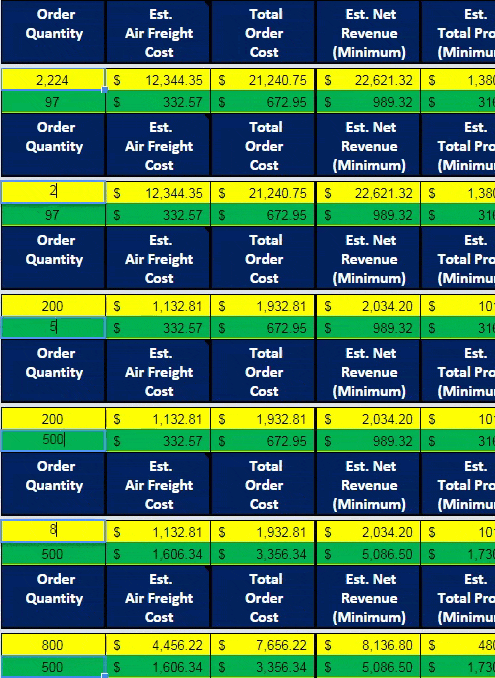
- Shipping Cost Estimate: On my workbook, you’ll see that I actually account for using different shipment methods earlier in your business…
This is because all new sellers will start with Express shipments, and as their product starts selling more – they will move into Air Freight Shipments or even Sea Shipments…
Let me simplify a LOT of complex knowledge down to this for you…- Express = $7 per kg
- Air Freight = $4.5 per kg
- Sea Freight = $0.50 per kg
Because my workbook does all of this for you, you don’t really need to worry about those numbers yet. I just want to let you know what’s happening with my calculations.
And remember – you already told your workbook what the Weight (lbs) Per Unit, and the workbook is using that number here to fuel these shipping estimates 😉
- Total Order Cost: If you’ve been following along, you’ve just built a very intelligent workbook. It already knows…
- How much inventory you’re going to need
- How much that inventory is going to cost you
- How much it will cost to ship that inventory into your warehouse (or fulfillment center like FBA)
- How much you’ll pay in fulfillment and seller fees for each unit sold
With all of this information, we can easily determine what the total cost of each order will be.
Now keep in mind, you’ll likely end up paying a bit less than this. Most sellers easily negotiate a 30% up-front deposit for their inventory, and then pay the remaining 70% after its shipped.
Remember – this step is about comparing data to find the most profitable product opportunities in your list of ideas…
Now we get into the really cool stuff that 99.9% of sellers will never research…
- Net Revenue: This is the exact amount of money you’ll receive back into your bank account from Amazon after your inventory sells out.
- Total Profit: This is the exact amount of profit you’ll make after paying for EVERYTHING (shipping, handling, importing, fulfillment, seller fees, etc).
- Net Profit Per Unit: The same thing as Total Profit, but expressed on a per unit basis (rather than showing total profit of the order). This allows you to see how product profitability changes with different order quantities.
- Net Profit Margin: Here is the real-live net profit margin you could expect on this product across different order quantities & shipping methods.
- Return on Investment (ROI): This is very similar to net profit margin, but instead shows you how efficiently you’re using your capital. This won’t be as useful when you’re first starting out, but will become very useful when you have lots of different products (and you’re looking to sell only the one that make the most sense for your business).
Keep in mind my workbook shows all of these results based on both Minimum Price (based on ‘Avg Price’) AND Ideal Price (based on ‘Desired Selling Price’).
Final Step: How to Actually Pick Your Winning Product
You’ve now done more product research than most sellers ever will. You have every piece of relevant information needed to make your decision (and none of the useless clutter that slows most people down)…
Your job now is to scroll around and compare all these products against each other, and to SELECT A WINNING PRODUCT!!!
As you’ll see by looking at your data, there are some products that simply won’t make sense. They might have extremely low profit margins / profit per unit, or they might require such large inventory orders that it’s simply out of your current budget…
All of that is fine. Because somewhere in your data, lies at LEAST one incredible product you can use to launch your business and build a new life for yourself.
Ask Yourself These Final Questions…
It’s pretty obvious at this stage how you can compare these results you’ve got, so I won’t spend much time explaining that…
Instead, I’ll give you some additional questions you may want to ask yourself to make that final choice between your winning products…
- Is this an impulse purchase that would not require much research before buying? You want to be selling impulse purchases for your first few products (and luckily, most products in our desired price range are impulse purchases).
- Is this product fragile or hazardous to ship? That could severely increase shipping costs & returns.
- Do some of these products have more/less moving parts than others? More moving parts is BAD when first starting out.
- Could the top 10 listings for this search term use improvement? Are the current sellers missing images, or could their images be improved?
- Can I match (or exceed) the current product & listing quality of existing sellers? You want to be selling high-quality products that your customers will love (that’s where the high margins are at).
- Is there a passionate community about this product? You might want to leverage influencers, FB Groups, and similar things in the future. A product with a thriving and excited community is better than selling something without that spark.
- Does this product somehow encourage recurring purchases or have an obvious product pathway? The final thing I think about, is what ELSE comes AFTER each product? Are there some products on your workbook that have an obvious pathway to launching MORE products to those same customers? I like to turn my products into product LINES and BRANDS, so this is important to me…
Now – Pick Your Winning Product!
I’ve worked with over 7,000 new sellers over the past few years, and I know that THIS is the MAIN point of failure…
MOST new sellers never get past this point. They freeze up and get scared, and they go back to the 9-to-5 grind…
You MUST understand – you’ve now done more product research than almost anybody I know. You HAVE all the information you need to KNOW which products will win or lose.
The next step is for you to TAKE THE LEAP…
You must accept that there is SOME RISK INVOLVED with starting new businesses. And now it’s time for you to TAKE YOUR RISK.
I’ve given you more here than any existing successful seller had when they first got started. So now YOU NEED TO GET STARTED!
Have More Questions For Me?
This is one of my main mega-guides that I keep constantly up to date. So you can bookmark this and come back to reference it in the future 👍
If you have additional questions or confusion after reading this guide, you should do one of the following…
- Read the comments below (or even post your own) – I spend most of my time helping new entrepreneurs launch their businesses, you know 😉
- Join me on my next live webinar – /ecommerce-workshop”> /ecommerce-workshop”> /ecommerce-workshop”>How to Launch a Profitable Amazon FBA Business From Scratch
For continued reading and learning, here’s some awesome mega-guides that go well with this one…
- How to Make Big Money Importing Products From China – The Rise and Fall of My Empire…
- The Alibaba Insider Guide: How to Easily Buy From Alibaba
- How to Sell on Amazon: The Ultimate (Step-by-Step) Beginner’s Guide
- Amazon Seller Tools: The Complete List (for 2019)
- 21 Amazon Chrome Extensions for FBA Sellers
That’s it – you did it! Congratulations on consuming the most advanced piece of content I’ve ever written 🎉
Let me know what you thought, and make sure to go do the damn thing!


Thank you very much for this in-depth guide. It has everything I need to launch my next product with much confidence. I tried to download the workbook guide multiple times, but the system is not sending the free guide to my inbox. Many of the guide sections depend on this worksheet that I really appreciate it if you can send it to me. Appreciate your assistance
Hi Will,
Thanks again for the great article you wrote.
About the product discovery stage, when I’m searching for products on Amazon, I have some products on the first page that doesn’t match exactly what I meant to look. For example, I searched for “Foot Soaking Bath Basin for pedicure and massage.” Some of the products are simple and some with extra benefits.
Do I need to count all the results or to filter just what are the same products?
Hi Will,
I’m just discovering this post in 2020. Better late than never, I guess.
I’m a ebay reseller (new at that), but I’d like to try Amazon once I get a grip on the first. Do you feel that the workbooks/spreadsheets are applicable to this platform? I feel that all the nitty-gritty details and points in your spreadsheet are universal, but I don’t want to make that assumption. Furthermore, do you feel that the principles outlined in this makes sense for someone who wants to focus solely on reselling?
I look forward to your thoughts.
Hey Will,
I have never commented on the web before but I really wanted to take the time to thank you for all your hard work in these guides..they are amazing! I’ve read so many different guides and watched so many videos but yours are the best by far. I love how you really show your personality through your writing and videos, so interesting, insightful and a really enjoyable read..I’m hooked. I’m going to use all of this information to change my life!
Thanks so much.
Stay Awesome!
Kimmy
Hey Will. You state “I’ve now personally sold over $100-million in physical products online (for new readers – you can view my current sales stats here)”
Question regarding your “personal” sales numbers. Are these businesses you personally started from scratch and brands/products you developed? Doing a quick google search it appears that the company Simply Organic Beauty was possibly created by your father and Holistic Hair maybe you possibly created as a piggyback site selling his products and using those exclusive distributor relationships? If so, that would be somewhat deceptive to not disclose but instead claim those as your personal sales…considering 90% sales is via Simply Organic, am I wrong? I think your readers would transparency with things like this and to know what you “personally” have done (started) on your own.
Thank you for the great article. I just found out about you and I wonder if you update the sheet for products as this article is 2 year old. I and many new students like me would be very happy if you put new list out there. thank you
I really appreciate the well written and beautifully described tactics in business. i am an aspiring amazon entrepreneur and all the info here has been very useful but i just want to know where i can buy products from and how do i get them to amazon fba centers and how do i actually get started.(after finding my product).
Hi in your guide you recommend pay the tool viral launch but what pricing plan do you recommend me, I want to start selling my first product because I saw the beginner plan is very simple so is it better buy the pro plan or the beginner?
Hey Abraham, you want to keep your costs as low as possible when you’re starting out. The beginner plan should be good to get started and to launch your first product. Remember stay lean and don’t spend all your money quickly.
I have been looking for products in JS to start in FBA I have been doing different searches in Amazon Mexico for more than 1 month but it sends me to very saturated products or where there are no possible improvements in the product, apart from not meeting the criteria to start selling that product in FBA and in some cases I find very limited searches where there are only a few sellers selling but they do not have many sales or even are prestigious brands.
Amazon Mexico is a small market compared to Amazon USA so there are products with good sales but a few sellers are making those sales.
In this case they recommend me to do since if I continue doing searches I will see the same products.
Hey Abraham, thanks for reaching out and reading the article. It would make sense to start selling on Amazon US because its a larger market where you can reach sellers. It happens often with these smaller markets where there aren’t many products or opportunities and then the solution becomes to sell on Amazon US. Is that something you’re open to doing?
Yeah, I’m thinking about but if I sell on Amazon is more expensive well with the fees of FBA. I need to think what is the market for me thanks for the help
Yea it completely depends what you want to do. Amazon is a great place to start when you don’t have an audience. Once you have sales on Amazon and an audience built up you can move on to your own website.
Thank you so much! I read every your post about Amazon niche sites. They’re so great and useful for me.
Thank again!
Good luck for you!
Thanks for checking out the article Rahul!