

Our last blog post about how Amazon’s algorithm ranks products was a huge hit, but everybody kept asking us one question…
Are there any tricks to selling on Amazon you can use to rank a new product FAST?
And I’m happy to report that YES – there are several Amazon tricks 🙂
Here’s What We’re Covering:
- Amazon Traffic Hack #1 – Winning the Buy Box
- Amazon Traffic Hack #2 – ASIN Piggybacking
- Amazon Traffic Hack #3 – Custom URL Queries
- Amazon Traffic Hack #4 – Vendor Powered Coupons
- Amazon Traffic Hack #5 – Automated Tools for Amazon Sellers
- Wrapping This Up…
Here’s the most effective Amazon search tips, hacks, and schemes you can use to increase your Amazon seller ranking for new products quickly…

Amazon Traffic Hack #1 – Winning the Buy Box
Truthfully, the biggest tip for selling on Amazon that you need to know is how to win the Buy Box. so this is a crucial part of successfully selling on Amazon, especially if you’re not creating and manufacturing your own products.
Here’s an example of what it means:
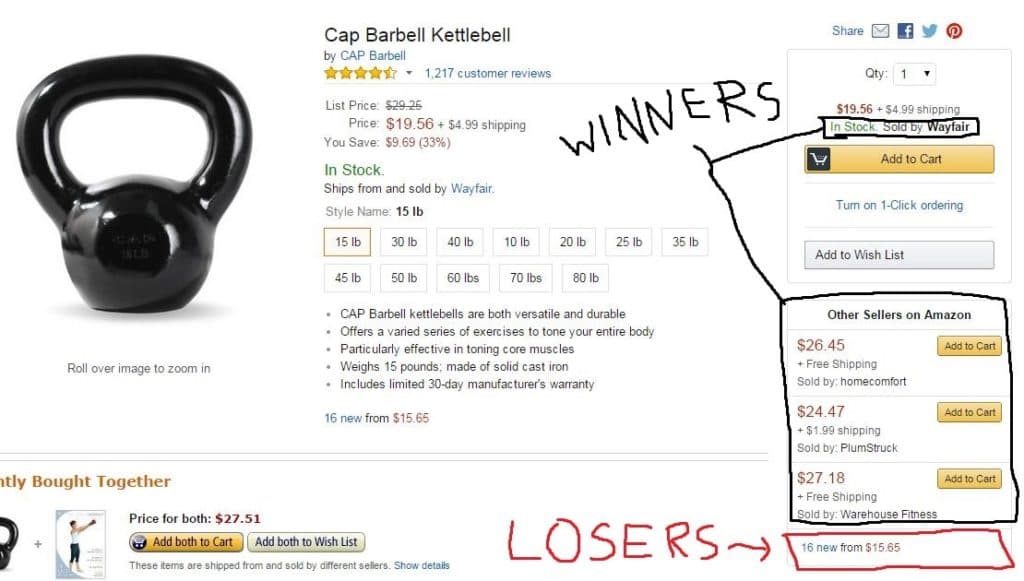
Look, of the 20 sellers for this product, only 4 of them are shown on the product page. You can bet that these four sellers are getting most of the sales for this listing…
If you’re one of the 16 losers for this product, what could you do to win the Buy Box?
Important Buy Box Metrics
First, let’s take some time to review known Buy Box metrics. They can basically be grouped into three categories. For reference, you can see the first page of sellers for the kettlebell listing above, shown to your right.
Pricing
Understand, this is without a doubt the most important Buy Box metric.
So even though the image of the product listing above says that there are other offers “from $15.65”, closer inspection of the listings reveals that those cheaper options are actually more expensive once you take shipping into account.
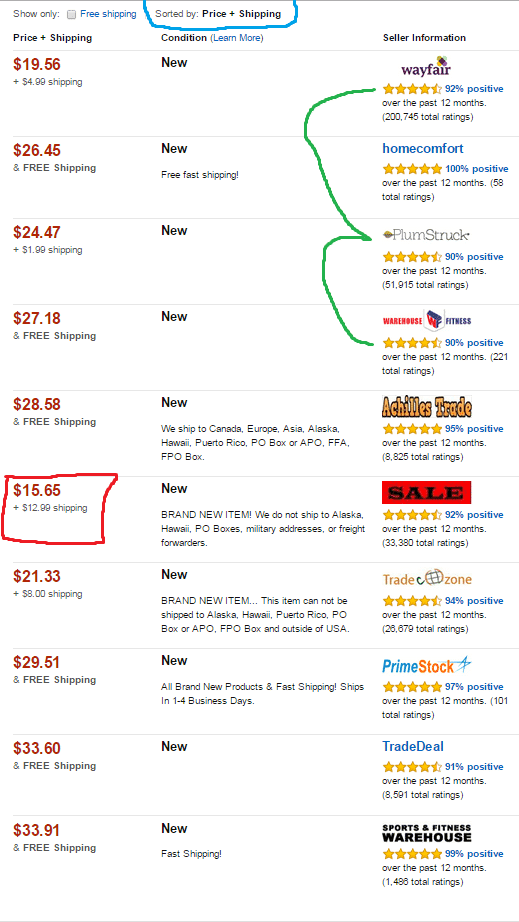
By default, Amazon lists products on this page in order of Price + Shipping, and that carries into the Buy Box unless one of the other metrics are way out of whack.
Shipping Performance
Normally, Amazon puts an enormous priority on fast, hassle-free shipping for their customers. That’s why they encourage sellers to use their Fulfilled by Amazon program.
And, shipping performance includes a number of individual metrics, including Order Defect Rate (ODR) and Perfect Order Percentage (POP), both of which we talked about in our last post on Amazon ranking factors.
- ODR (Order Defect Rate) is how many orders are canceled, returned, shipped improperly or get negative feedback for any reason.
- POP (Perfect Order Percentage) is how many orders go perfectly smoothly without any customer intervention.
Therefore, Amazon keeps track of how often you run out of stock, so try to maintain a 100% in-stock rate.
Seller Rating
It seems to me that the magic number for the seller rating is 90%.
Now the listings shown to your right are a great example. Every seller on the first page has a 90% rating or above. However, you can see that a seller with a 90% rating has a higher Amazon seller ranking than a 100% rating.
It seems that as long as you hit 90% positive feedback, anything extra won’t have a huge impact on the Buy Box. Giving the most accurate and informative product descriptions is the best way to have a happy customer. If your product is not exactly or better as described then the customer won’t be happy and unhappy customers tank your ratings.
Conversely, it’s uncommon for a seller with a <90% rating to have the Buy Box.
How to Win the Buy Box
What are the specific steps? Turns out, there are only three:
1. Make sure you’re eligible – Your product must have the same ASIN as the listing you want to be featured on (more on this below). You also must meet all the criteria listed above.
2. Lower your price – If you’re eligible, pricing is pretty much the sole determining factor. All you have to do is find out what your competitors are selling your product for, and offer to sell and ship it for one cent less. Voila, you rank higher in the Buy Box.

3. Use Fulfilled By Amazon – You’ll get a special orange Fulfillment By Amazon icon (see above) on your seller listing when you use FBA. You’ll also be able to compete on Amazon Prime listings, which is reason enough to join by itself. Plus, Amazon is constantly trying to push sellers onto FBA, so the sooner you hop on the bandwagon, the more rewards you’ll reap.
(NOTE – While lowering the price is certainly a good strategy to rank higher, it is not always a good long-term business strategy. You do NOT want to compete on price alone, as this will only start a price war/race to the bottom)
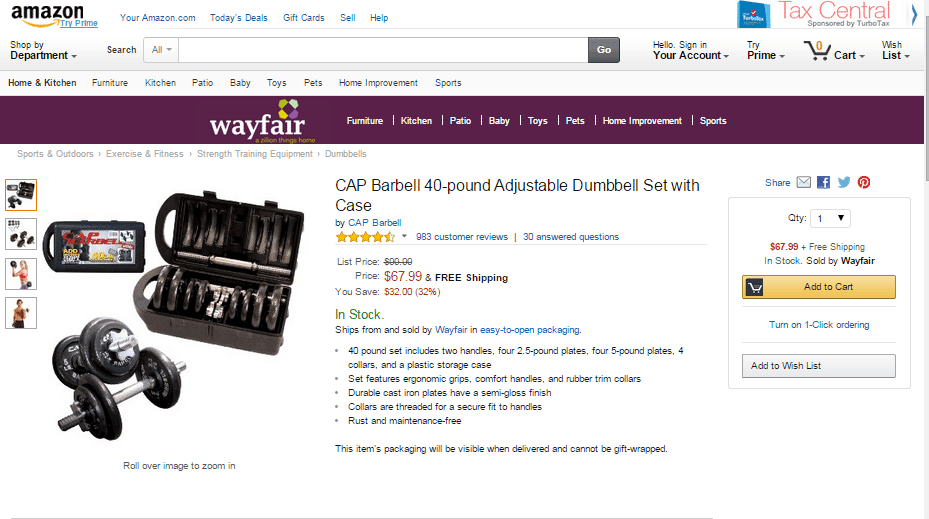
One of the top sellers you see in the list above is WayFair. As I was poking around Amazon, I noticed them showing up a ton in our searches. They have over 200,000 reviews and this seller clearly knows what they’re doing… Just about every item in their shop is winning its Buy Box. Getting Amazon reviews has to become systematic to generate sales.
You can see another of their Buy Box-winning products below, shown here from inside their Seller profile shop:
Amazon Traffic Hack #2 – ASIN Piggybacking
If you know the Buy Box hack, your earning potential on Amazon instantly skyrockets. One of the most powerful Amazon tricks you can use is Amazon ASIN piggybacking.
Look:
How to Find Your Amazon ASIN Number
There are 3 different methods to find your Amazon ASIN number: web address, listing details, or you can use a software tool for ASIN lookups.
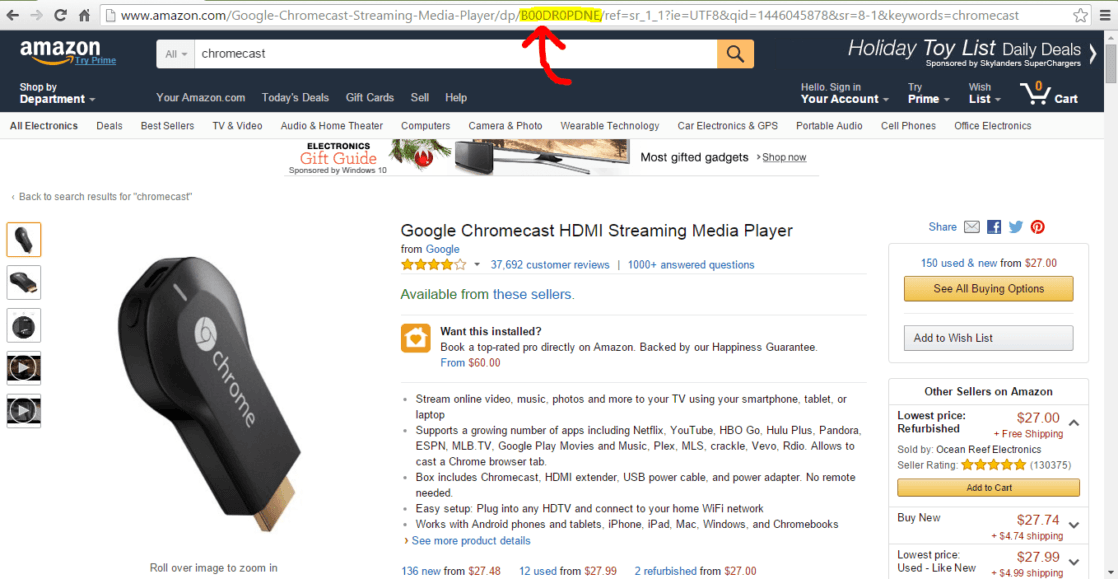
We think the fastest way to find the Amazon ASIN is to use your browsers address bar when you find the product you’re looking to sell.
The Amazon ASIN will be after the “dp/”.
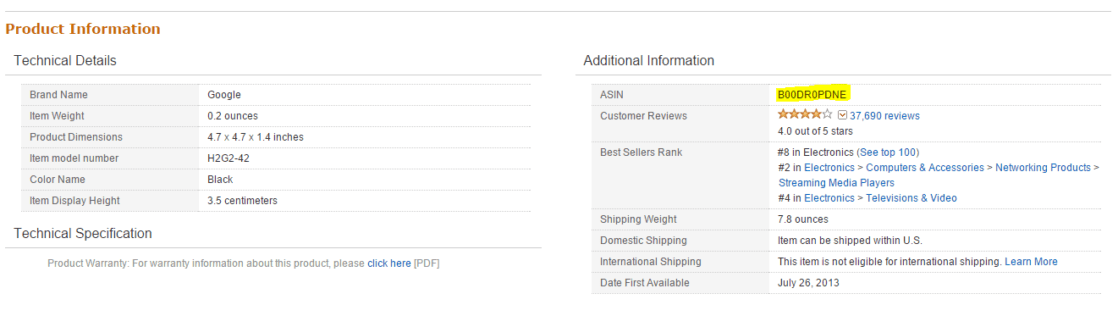
The next place to find the Amazon ASIN is in the details section of any product listing, near the bottom of the Amazon listing.
Now:
Steps to Amazon ASIN Piggybacking:
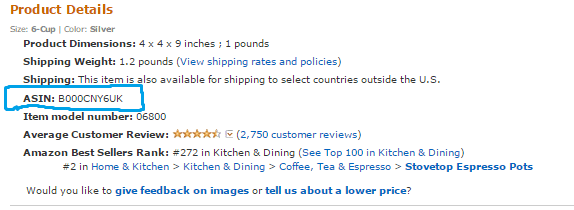
- Identify a successful non-unique product and find its ASIN. The Amazon ASIN is listed in the Product Details section of the product listing. (shown below)
- Research the manufacturer to figure out how you can start reselling the product for yourself. Find out how much it will cost wholesale, and calculate what it will cost you to ship. Is there room between that number and $0.01 less than the current Buy Box-winning price for you to make a profit?
- If the answer to and #2 is YES, contact the manufacturer and start selling. You’ve just found a gold nugget!
- If the answer to #2 is NO, you may still be able to work out a special deal with the manufacturer if you ask for it. However, if you don’t think it’s worth it, look around for other products in the same niche… Chances are, there’s money to be made on a slightly lower ranked product.
Blackhat Amazon ASIN Piggybacking
As you can probably guess, some sellers have developed a blackhat form of ASIN piggybacking. Basically, it involves finding knockoffs of popular products and listing them with the same ASIN as their non-knockoff counterparts.
This works because the process Amazon uses to identify and suspend misleading sellers is extremely cumbersome. The seller whose listing is being illegitimately piggybacked has to report the seller and order one of the suspected counterfeit seller’s products to prove that it is indeed a different product.
It should be noted here that Amazon doesn’t have anything against selling cheap knockoffs. They just don’t like it when you lie about what it really is or who really made it. So, I’m not telling you this method because I condone it, but merely to keep you informed doesn’t Amazon seller. Someday it could happen to you! Know how to protect yourself from having your product listing hijacked.
In order to keep your Amazon ASIN piggybacking above the table, make sure that you’re shipping the exact same product – with the same brand, SKU and manufacturing code – as the listing you’re trying to piggyback. You can’t even use your own UPC code. You have to list the product with the sellers ASIN.
Amazon Traffic Hack #3 – Custom URL Queries
The other really common tips for selling on Amazon that we had after our last post was for more information on how Amazon uses URL queries for search results and what you can do to take advantage of that.
So to show you what’s going on behind the scenes when you use Amazon, let’s start by looking at the URL for a search term you might want to increase your amazon seller ranking for. Therefore, when I search for “stove top espresso makers” from Amazon’s home page, here’s the URL that we get, shown in the image below:
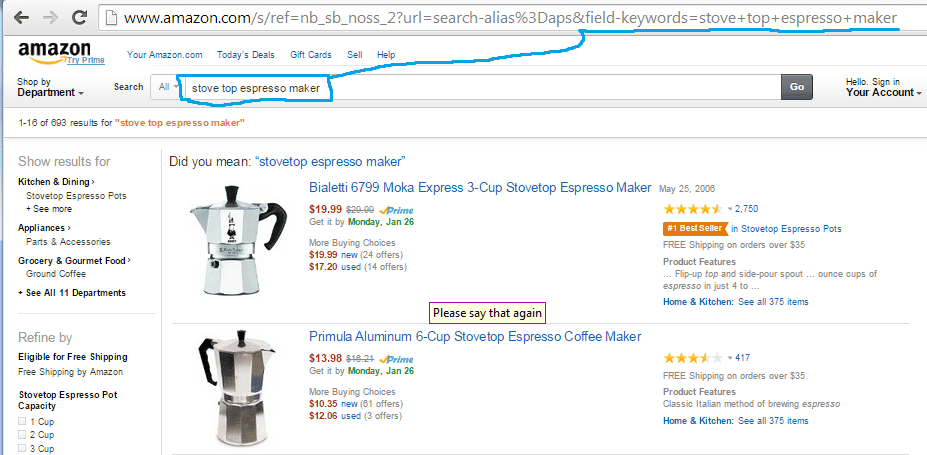
In case you can’t see, this is the URL:
If we dissect this URL, it’s easy to see that the &field-keywords= string is what Amazon uses to ID which search results to show. The /s/?url=search-alias is how Amazon tells itself to query a search results page, automatically sorted by best-sellers.
So, if we’re building links or promoting this page, we could strip the URL down to this:
http://www.amazon.com/s/?url=search-alias&field-keywords=stove+top+espresso+maker
Quick Note: For some reason, removing the ?url=search-alias returns a different set of search results… Not sure why, but either way make sure you keep that in if you want to make it look like someone searched for that keyword from Amazon.
Now, let’s see what happens when we click on a product from the search page:
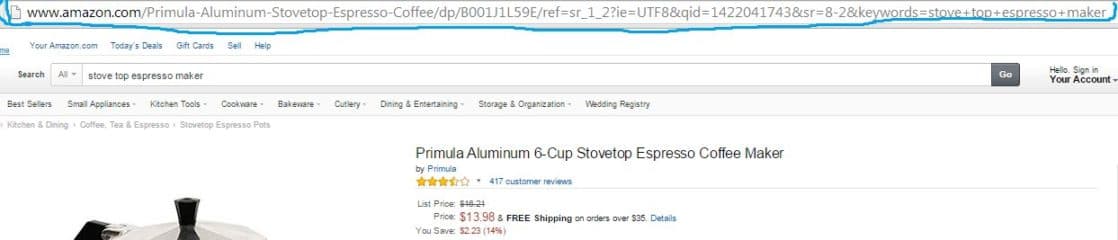
http://www.amazon.com/Primula-Aluminum-Stovetop-Espresso-Coffee/dp/B001J1L59E/
ref=sr_1_2?ie=UTF8&qid=1422041743&sr=8-2&keywords=stove+top+espresso+maker
The part of the URL that’s bold is all that you need to bring up this product page in your browser. Everything else is there to tell Amazon how the viewer arrived at the listing.
You can see the &keywords=stove+top+espresso+maker tells Amazon that I arrived at the listing by searching for “stove top espresso maker”.
There are a couple other keyword strings to be aware of. You may have to do some experimenting one your own to figure out specific URL string combinations that delivers the page you want to see, but knowing these queries will give you a great starting point:
&node= is what Amazon uses for categories. If you click on “All Departments” and enter the Kitchen & Dining category, you’ll get this URL:
http://www.amazon.com/kitchen-dining/b/ref=sd\_allcat\_ki?ie=UTF8&node=284507
Just like with the &field-keywords= string, the only part of the URL necessary to tell Amazon to bring us to the “Kitchen & Dining” category is the &node= query, in this case &node=284507. So, if we wanted to link to this page, you could strip down the URL to this:
http://www.amazon.com/s/&node=284507
&field-brandtextbin= is another URL string you’ll want to be familiar with. It’s what tells Amazon to filter your search by a brand name. Since many customers already know what brand they want, you may be able to use this query for tracking and SEO purposes.
To bring everything we’ve learned about custom URL queries together, let’s say we wanted to bring up the search results page for the term “espresso maker” in the Kitchen & Dining category, filtered by the Breville brand. Here’s what the URL would look like:
http://www.amazon.com/s/&field-keywords=espresso&20maker&node=284507&field-brandtextbin=breville
One important thing to note here the use of the &20 character instead of the + character in the URL. This tells Amazon to separate your keywords with spaces instead of actual plus signs.
The Best Way to Optimize Your Listings with the Right Keywords
How to Use the Custom URL Queries Hack
You may remember that Amazon keeps track of which products people end up buying after searching for a given keyword. They then use that data to help them decide which products are most relevant to the original search term.
This means that you can drive traffic to a product page from instagram, facebook, or google using a custom URL and make Amazon think all those people came from a search result for your target keyword or brand. That way, every sale you make from that link counts toward that specific search term’s relevancy!
Make sense? No? Don’t worry, here’s a real-life example:
Let’s say you want to make this product rank higher for the “best espresso maker” keyword in the “Breville” brand:
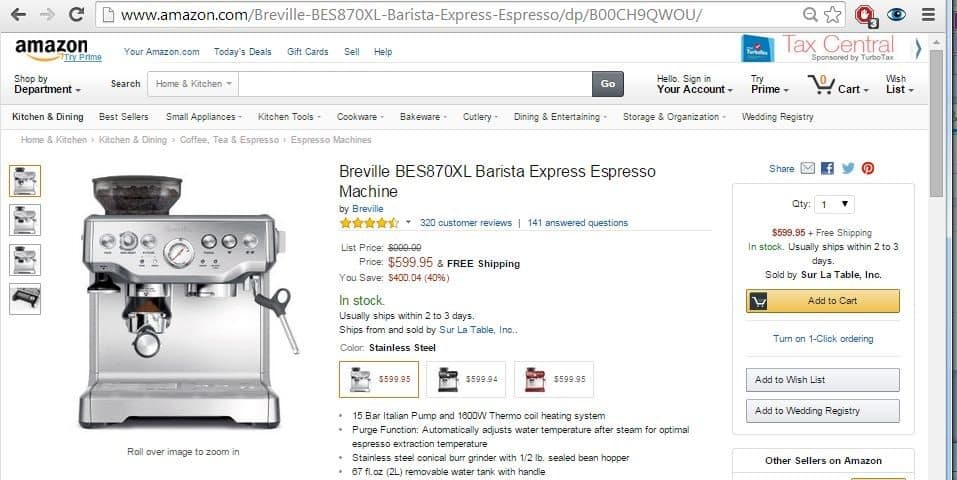
You could theoretically make Amazon think that every visitor to this page came from the search page for “best espresso maker”, filtered to the Breville brand, by directing traffic to this URL:
Now, every purchase a visitor makes through that link would count as coming from our target search term, “best espresso maker”.
Keep in mind, this isn’t 100% proven to work, but everything we know about Amazon’s ranking algorithm tells us it should. Plus, the absolute worst-case scenario is that you’re driving extra sales to one of your products… Amazon isn’t like Google where they’ll punish you for trying to optimize for their search engine.
Quick way to use the Custom URL Amazon Traffic Hack
By the way, if you’ve got lots of capital, you can fast-track this process yourself:
- Search for a term you want to rank a product for
- Click on your product
- Buy it
- Change your IP (make sure to clear your cache) or get on a different computer.
- Repeat!
Of course, if you had that much capital – it may be better to spend them on Amazon Product Ads 🙂

Amazon Traffic Hack #4 – Vendor Powered Coupons
If you’re an Individual Seller with a Pro Merchant account, a Professional Seller or a Vendor, then you can use Amazon’s built-in promotion tools. The savviest of shoppers always make use of Amazon’s daily deals.
You can access these deals for yourself by clicking on the today’s deals link in the top-most navigation menu next to the Amazon logo (underlined in green below). That link will take you to a page like this:
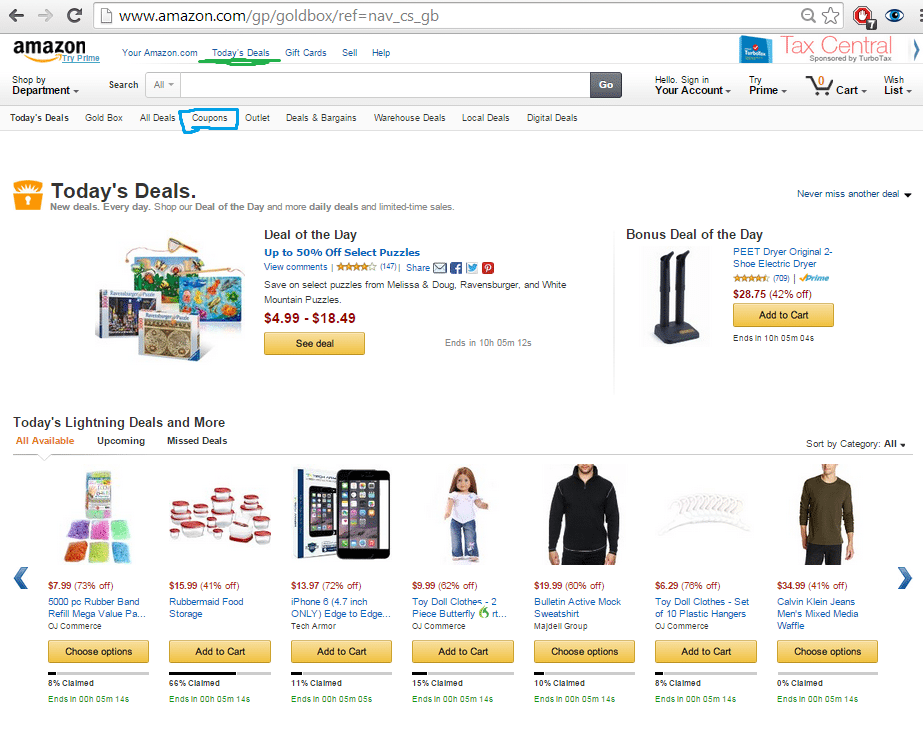
As you can see, this section of Amazon’s website is almost a department unto itself. Promotions are given their own unique links and listing pages. The part I’d like to draw your attention to is the Coupons link, highlighted in the blue box above. This page takes you to a list of Amazon’s most popular Vendor Powered Coupons (VPC) in a variety of categories. See the page for yourself below:
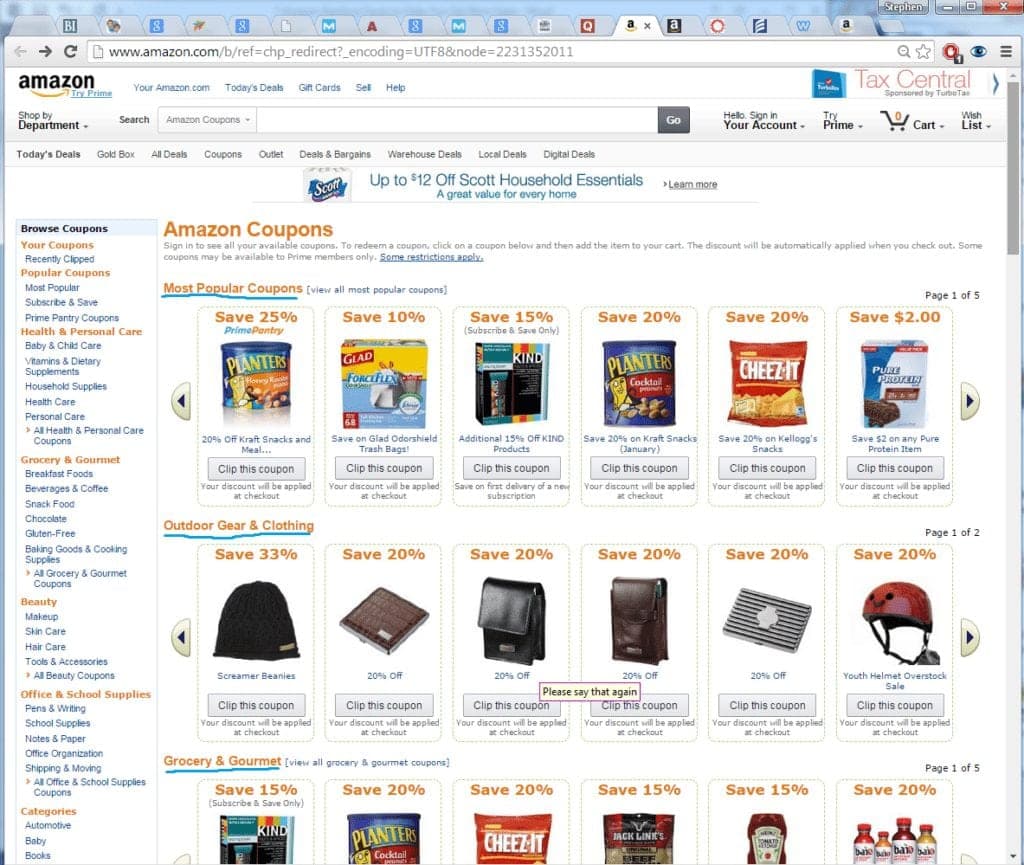
Scrolling down the page, we see coupons for Outdoor Gear & Clothing, Grocery & Gourmet, Baby, Household Supplies, Electronics, Personal Care Appliances, Kitchen, Industrial & Scientific, and Other Coupons. There are coupons categories for just about everything except for digital content!
Here’s what a coupon page looks like:
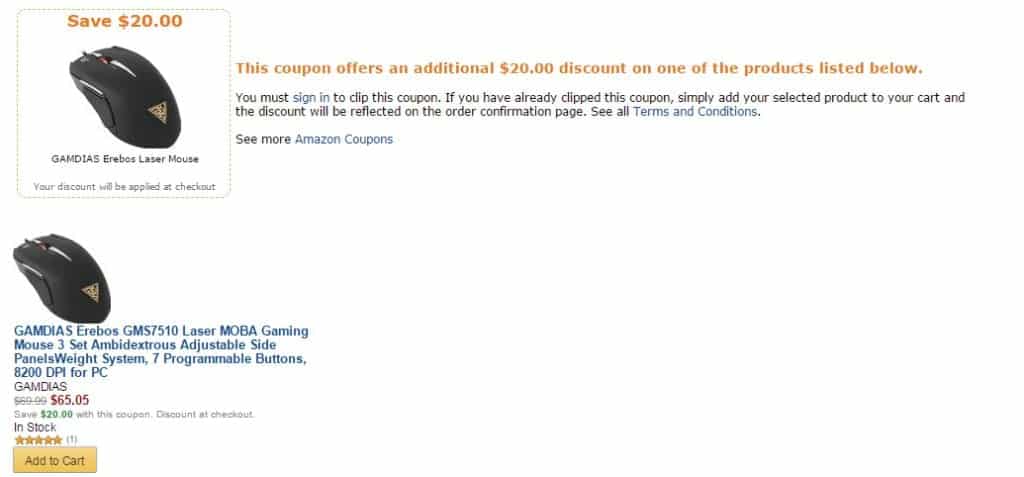
(Note: you won’t see this page if you’re signed into Amazon; instead the coupon will automatically be added to your cart)
And depending on your seller status, you can create your own VPCs for any products you sell.
Tricks to Selling on Amazon Using Vendor Powered Coupons
Here are four straightforward ways to make the most of your VPC promotions:
- Promote VPCs just like you’d promote any other Amazon product listing. Coupon pages have their own independent sales rank. So, if you’re a new seller or trying to compete in a tough niche, you may be able to get more eyes on your product by promoting a coupon for it instead of the listing itself.
- Create a bigger discount or coupon than your competition. Since Amazon tries to give customers the best possible deal, you only need to offer a little bit better of a coupon than your competition to maximize your chances of getting showcased on the Coupons page.
- Promote your VPCs on third-party deals sites. This is a really sweet hack that can get you decent levels of traffic with very little effort. Simply search Google for “submit a deal” and you’ll get a list of 500,000+ websites that all want to showcase your deals. Submit your coupons to 10 of these sites per day because not all of them will take online coupons. And if your deal is eye-catching enough, you should start seeing some steady traffic flowing in.
- Give your VPCs out to friends and family in exchange for reviews/sales metrics. This is also an awesome hack, which most of our clients use with great success. You can set up a VPC and discount your product down to your total costs (so you’re not taking a loss on each sale, but breaking even). Then give this VPC out to friends and family, and have them buy it through Amazon on their own. Most people will be ecstatic to receive such a deeply discounted product, and you’ll get a ‘Verified Purchase’ review – as well as a boost in your initial sales data!
Important – For #3 to work you really need to offer a standout deal. The penny-pinching you can get away with on Amazon probably won’t be enough to get you featured on the most popular Daily Deals sites.
So not everybody can make use of these coupons or Amazon’s other built-in promotion tools. However, if you have the right type of account, be sure to check them out!
Amazon Traffic Hack #5 – Automated Tools for Amazon Sellers
Finally, no discussion of Amazon Traffic hacks would be complete without talking about the most important part of scaling any /ecommerce-workshop”> /ecommerce-workshop”>e-Commerce business…
Automation!
As you continue reading, we’re quickly going to look at three of the most powerful ways you can automate selling on Amazon.
(check out this overview of the best Amazon Seller Tools for automating your sales on Amazon)
Please note! This is not one of those posts where we’re secretly trying to get you to buy a bunch of stuff. We’ve found free alternatives where possible, and there are no affiliate links anywhere in this guide.
- Keyword Research
One of the most common questions we hear from entrepreneurs transitioning from SEO for Google to selling on Amazon is, “How do I find good keywords?”
Well, the short answer is that there is no built-in keyword tool for Amazon. (But we cover 19 tools you can use there).
Amazon Keyword Search Tips
However, you can manually perform keyword research for Amazon.
- Identify a popular root keyword in Google’s Keyword Planner
- Enter that keyword into Amazon’s search bar followed by a random letter (a to z)
- Get Search Suggestions for that keyword.
You can see this process in action below:
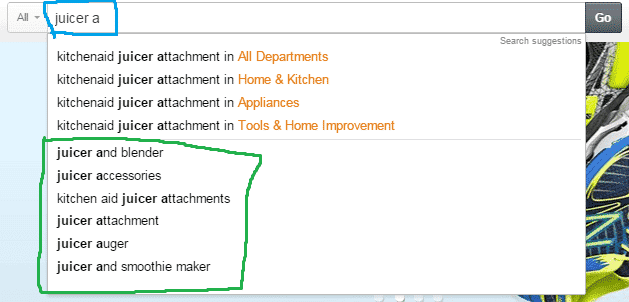
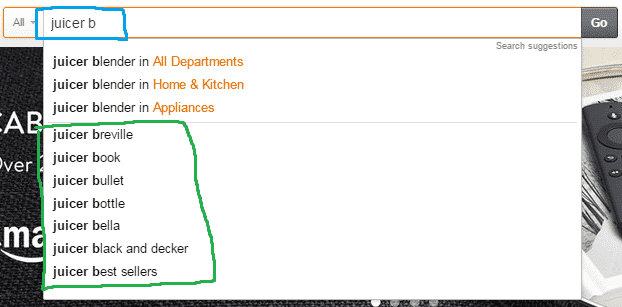
It won’t take long for you to realize that manually finding and recording the Search Suggestions for even one root keyword would quickly turn into a huge task.
What if you had a tool that automated this whole process for you?
Recommended Amazon Keyword Search Tools
- Tool #1: 100% free tool that does exactly that – it’s the KTD Amazon Keyword Tool. When you enter a keyword, it automatically queries Amazon’s search box for all the long-tail Search Suggestions for your keyword + each letter of the alphabet.
- Tool #2: A premium alternative, we’ve heard good things about MerchantWords (not an affiliate link). They typically use a system that pulls data from major search engines, identifies matching queries in Amazon, and then use an algorithm to combine that data and give you estimated traffic numbers. Still may be worth checking out for some.
- Product Re-Pricing
Using the Buy Box Hack a few times, you’ll start running into a problem… Your competitors are using the exact same tactics on you that you’re using on them. They’ll undercut you by a small amount to get placed above you in the Buy Box for your products.
What can you do about it?
Recommended Product Re-price Tool
Easy – invest in a tool that automatically reprices your products so that you always stay on top of the Buy Box. This is almost a requirement when you have lots of products for sale; there’s just no way to stay on top of pricing for all of them.
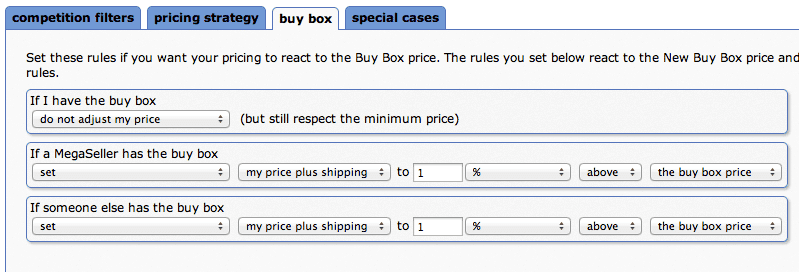
Tool #1: The best one we’ve found is Sellery because it’s a straightforward application that gives you control over when and by how much you reprice your products. Here’s a screenshot of the interface:
Tool #2: An alternative to Sellery is RepricerExpress. It does pretty much everything Sellery does with a similarly easy-to-use interface. The perks are that it’s a flat monthly rate instead of commission-based, and it claims to be one of the fastest large-volume repricers on the market.
(NOTE – Be careful when using Repricing Tools, and be sure to keep a close eye on all your product prices and repricing errors are not unheard of, and they can be devastating.)
- Listing, Inventory & Shipping Management
Finally, large volume sellers and vendors, especially those who sell their inventory across multiple platforms, will inevitably need a tool to manage inventory and shipping.
Recommended Amazon Inventory Management Tools
- Tool #1: If you’re an Amazon-only seller, the best tool we can recommend is InventoryLab because it’s an all-in-one inventory management system. You can create product listings, keep track of shipments and inventory, manage income and expenses, and analyze your business’s growth and performance over time.
- Tool #2: Now, if you are selling on Amazon AND an eBay (or a NewEgg seller, or one of the other six supported platforms), we recommend SellBrite. It sacrifices the accounting, financial and analytics tools of InventoryLab in favor of multi-channel inventory and listing management tools.
For example, SellBrite automatically keeps inventory for your Amazon store, eBay store and Etsy store all synced up so that you’re never showing duplicate products. You can also manage multiple stores on the same channel (if you have two Amazon accounts, for example). You can learn more about specific features on their website.
Additional resources to learn more:
18 Amazon Seller Blogs to Master the FBA Game
Wrapping This Up…
So, selling on Amazon doesn’t have to be intimidating, even if you’re a new seller. It’s the largest e-commerce platform in the world, and now you have all the tools you need to make the most of it. But in the end, nothing beats getting your hands dirty and actually putting these Amazon ranking hacks to work!
So what are you waiting for? Finally, get out there buy UPC codes and list your first product! Start with Retail Arbitrage if you’re looking for a smaller investment. But take action anyway!
TL;DR (Amazon Selling Tips)
- Use the Buy Box Hack by making sure your offer is eligible, accurate, and priced a penny lower than the competition.
- Get easy sales by piggybacking on the Amazon ASINs of successful products.
- Drive traffic to your product pages using custom URL queries to “trick” Amazon into ranking your products for high-volume search terms.
- Create Vendor Powered Coupons if you’re competing in a tough niche because they’ll have their own independent Sales Rank.
- Automation is the ultimate secret to seller growth – identify which tools will help you make the most sales.
Therefore if you have any other Amazon tricks, search tips, or seller ranking hacks, I’d love to hear about them in the comments below! See you there 🙂
146 Comments
So the main takeaway is that to win the buy box you need to be priced lower than the competition? Isn't that a race to the bottom? I thought the idea from previous posts was to compete by selling better: branding products, writing better descriptions, etc
Maybe I should have made that point #5 - I do not believe it's the most important Uri! Advanced tactics like the URL Search Query hack and Vendor Powered Coupons are much more effective for new sellers. Furthermore, I would not recommend competing on price alone! However, if you're playing a pure arbitrage game - you're going to have to in most cases - at least until you can start differentiating your product and brand. Sorry for the confusion...
Re. The 1 penny undercutting - are you trying to get n00bs to start a race to the bottom? Because this is how you get n00bs to start a race to the bottom.
Thanks for bringing up that important point Rob. There are many other aspects of being a successful Amazon seller - but when speaking solely about ranking hacks, price cutting is obviously a big deal. You can instantly go from the bottom of the list to the top. I'll be sure to add a disclaimer that this is solely for ranking your Amazon products well!
Advanced tactics here, thanks for sharing. I've been selling on Amazon successfully for 2 years now, and the first couple weeks of a new listing is always the worst. I will try to apply these on our next product launch - thank you for sharing!
Sure thing Ina, glad to help! No reason to wait for the next product launch though - many of these methods could help with your current listings as well! Worth a shot :)
That's a good point :) I'll go try now, and email you with the results!
Ah, now that's the spirit Ina! Good luck, I'll keep an eye out for that email ;)
Hi. Thank you for the post! How can you make a nice product description with some html? ?
Hi, Thanks for your great article. I'm new to Amazon, and I've got a question about writing "Product Description". I know using HTML codes are actually against Amazon TOS, but I need to use bold, italic and underline formats to write a readable description. I tried several tags such as <b>,</b> but Amazon doesn't apply the changes to my listing. Any idea?
Thanks Martin, glad you liked it! Unfortunately Amazon is really cracking down on using HTML in product descriptions. You can still get away with some basics elements (bold, italics, bullet list) - but Amazon is even starting to crack down there. I would get your description up ASAP - as Amazon has not yet taken down any existing HTML listings. They are just beginning to stop new ones...
See my reply to Martin above - he had the same question. Let me know if you have any other questions!
Then I would say WTF. Thanks by the way.
Haha no problem - it is definitely a bad situation for Amazon. I personally hope they loosen up on the HTML formatting - but at the very least, they need to level the playing field...
Thanks for the info. I did retail arbitrage prior to private labeling on Amazon and I found that it was really effective to price slightly higher than the competition. Even if you are a few cents higher but within 1% of your competition (depending on the category) you will share the buy box and possibly avoid triggering their repricer. This avoids the whole race to the bottom and still gets you sales.
Great article! Lot's of easy to implement hacks and details.
Hi, Thanks for another great post! I have one newbie question to ask you...When you are going to put your listing on Amazon do you go to the existing product listing and click the "Have one to sell? Sell On Amazon" button? Or do you do something different? I'm not sure how to go about listing new imported products as I have only ever sold used textbooks which I piggyback onto existing listings in the used section.
You have brought up a lot of good suggestions and I commend you on your investigative ability. I would like to caution sellers about just piggybacking on listings. We have had many clients over the years that have done this just to get into a bit of trouble. Yes it is nice to be able to find a listing that already has a ranking that is higher than others and just add yourself to that listing, but you have to make sure the listing is complete and has the correct information. Just last week we have had several clients that came to us asking for help in removing negative feedback from buyers complaining that they were not getting what they thought they should receive based on the listing. And they were right, the image showed one thing, and there was no information in the listing (title, bullet points or description) that stated otherwise. Therefore there was no recourse that could be taken on the part of the seller, and you know that Amazon's primary focus is on making the buyer happy. Your feedback rating gets too bad, Amazon will take action. You had also discussed generic product listings for items that were not a name brand product. Once again this is more tricky than you make it sound. There are many Sellers out there that are working very hard to create their own brand; they have designers, work with manufacturers to make products for them and have spent the time and money to get their brand trademarked. They are not Nike or Black & Decker or Otterbox, but they are brands that are recognized by Amazon through the Brand Registry. Not that many people are familiar with the smaller brands and just seem to think it is fine to attach their generic product to these listings. These are companies that have put a lot of effort into developing a following on Amazon and other marketplaces, just for someone who got a deal on a generic product that looks similar to add themselves to the listing. This not only takes sales away from the Seller who is developing the brand, it has also hurt the brand itself. Comments and reviews from buyers that dislike the product or find the quality inferior negatively impact these brands, but the buyer didn't get the brand item that they thought they were buying. Please have your readers make sure the listing is generic and not just a small brand. There are to many Sellers that are mistakenly adding products to listings that are actually brands (even though working with the trademark & copyright infringement group to have these generic products removed from our clients listings keeps us busy) that should be creating their own listings for those generic products and working to affect the ranking instead of taking advantage of the work another Seller has already done.
Vendor Powered Coupons (VPC) are only for Amazon to use... ex... Only for Amazon to use with products they buy directly from the vendors/suppliers.... As a product seller you do NOT have the option to use this strategy regardless of whether you ship personally or whether you use FBA. I've spoken with several people there... It could be used to grab & promote as an affiliate I guess, but that is chump change IMO compared to Private Labeling your own product.
This is really great info, unfortunately it doesn't seem to pally to books. Any advice to help place your books on the top of the list (besides keywords)? Thanks!